How Do You Ensure Cold Chain Compliance for Pharma?
Last Updated: November 27, 2026
Quick Summary
You ensure cold chain compliance for pharmaceutical shipments by controlling storage conditions, packaging qualification, vehicle and transit controls, and documented monitoring. Each shipment needs a record proving the product stayed within its labeled temperature range from dock to dock, including a written process for handling excursions.
Keep refrigerated product at 2°C to 8°C unless the label says otherwise.
Pre-cool the trailer before loading, never during, and log the setpoint.
Place sensors in the product zone, not near the door where readings swing.
Set alert thresholds inside the product range, not at the labeled limit.
Quarantine any drifted product until a qualified person reviews and signs disposition.
Is your reefer unit ready for the next pharma load?
We provide 24-hour mobile reefer repair and maintenance to keep temperature-sensitive shipments moving.
Table of Contents
How Do You Ensure Cold Chain Compliance for Pharmaceutical Shipments?
You ensure cold chain compliance for pharmaceutical shipments by controlling four things: storage conditions, packaging qualification, vehicle and transit controls, and documented monitoring. Each shipment needs a record that proves the product stayed within its labeled temperature range from dock to dock. This guide walks through each control in order, including how to handle an excursion when one happens.
Pharmaceutical cold chain compliance is the practice of keeping temperature-sensitive drugs, vaccines, and biologics within their labeled storage range through every step of storage and transport, with written proof that the range was maintained.
Most compliance failures we see start small: a pre-cooled trailer that never got checked, a logger that was never calibrated, or a handoff with no signature. The fix is a routine, not a rescue.
Below, we'll show you exactly how to build that routine, shipment by shipment.
Storage and Temperature-Controlled Handling Before Transit
Storage is where most compliance problems begin, long before a truck arrives. A shipment that sits too long on a warm dock has already failed before it moves.
Start with these controls:
Keep refrigerated product at 2°C to 8°C unless the label says otherwise
Store frozen product per its label, and keep ultracold products in validated freezers
Record storage temperatures on a set schedule, not just when someone remembers
Mapping Product Temperature Ranges
Every product on your shelves has a labeled range. Map them before you ship anything.
Common ranges look like this:
Controlled room temperature: 20°C to 25°C
Refrigerated: 2°C to 8°C
Frozen: -20°C or colder
Group products by range, then build shipping lanes around each group. A mixed pallet with three ranges is a compliance risk, not a convenience.
Cold Chain Packaging Qualification for Validated Shipping Containers
Validated packaging is the barrier between your product and outside heat. Qualification proves the packaging actually works for the lane and season you plan to use.
Run these steps:
Pick packaging rated for your transit time, not just your average trip
Test it against the hottest and coldest conditions your lane will see
Include the coolant type and amount in the written spec
Keep the qualification record with the packaging, not in a drawer
Re-qualify whenever you change packaging, coolant, or lane
Insulated packaging loses performance when it is packed wrong. A common mistake is over-packing coolant, which can freeze product that should stay liquid.
Refrigerated Vehicle Qualification and Transport Controls
A refrigerated vehicle is only compliant if it has been qualified for the job. Qualification means you can show the unit holds temperature across a full run, including door openings.

Run these checks before every trip:
Pre-cool the trailer before loading, never during
Confirm the unit holds setpoint through a loaded test run
Check door seals, curtains, and air chutes for damage
Watch out: a unit that cools fine empty can fail under a full load. Our guide on signs your transport refrigeration needs service covers what to look for, and fleet operators can read more in how to maintain cold chain across a fleet.
Pharmaceutical Cold Chain Monitoring in Transit
Monitoring in transit turns your controls into evidence. Without it, you have no proof the product stayed in range, and no way to reconstruct what happened if a receiver questions a load.
Use continuous monitoring, not spot checks. A monitoring device should record at a set interval, store the data, and flag any drift. Place sensors where product actually sits, not near the door where readings swing.
Choosing Between Data Loggers, Real-Time Trackers, and Hybrid Systems
There are three practical monitoring architectures, and the right choice depends on lane length, product value, and how quickly you need to react.
Single-use data loggers. Low cost per shipment, no connectivity, and data is only available when the device is downloaded at delivery. Best for short domestic lanes and low-to-mid-value products where a post-delivery review is acceptable.
Real-time trackers. Cellular or satellite connectivity pushes temperature and location data to a dashboard during transit. Higher cost per shipment, but they enable intervention before delivery. Best for high-value biologics, long or multi-leg lanes, and any shipment where a mid-route excursion would be unrecoverable.
Hybrid approaches. A real-time tracker plus a redundant single-use logger in the same container gives you live alerts and an independent record. Common on clinical trial shipments and other high-consequence loads.
A common pattern is to standardize on one logger type per lane so that data formats, calibration records, and download procedures stay consistent across shipments.
Sensor Placement That Produces Defensible Data
Where the sensor sits determines whether your record is meaningful. A logger taped to the inside of a door will read warm every time the door opens, even when the product is fine.
Place at least one sensor in the product zone, surrounded by or adjacent to the payload, not in the air gap near the door.
On palletized loads, place sensors at the top, middle, and bottom of the pallet to catch stratification.
For validated shippers, follow the sensor placement used during qualification; changing placement invalidates the comparison.
Watch out: a single sensor in a multi-pallet trailer can miss a warm pocket at the rear. If your qualification testing used multiple sensors, your routine monitoring should too.
Setting Alert Thresholds and Escalation Criteria
Alert thresholds should sit inside the product range, not at the limit. If a product is labeled 2°C to 8°C, an alert at 8°C is too late; by the time it fires, the product is already out of range.
A workable escalation ladder looks like this:
Warning alert (for example, 6°C on a 2°C to 8°C product): notify the shipper's operations contact and increase monitoring frequency.
Critical alert (at or beyond the labeled limit): notify the quality contact, begin the excursion procedure, and document the time of notification.
No response within a defined window: escalate to the on-call quality lead and, for real-time tracked loads, consider rerouting or intervening with the carrier.
Define the response window in writing before the shipment moves.
Calibration and Device Records
A temperature data logger is only trustworthy if it was calibrated. Build calibration into your routine.
Calibrate each logger against a reference on a set schedule, and keep the certificate with the device record.
For single-use loggers, retain the manufacturer's calibration certificate by lot number.
Replace sensors that drift or fail, and document the swap.
For deeper guidance on setting up in-transit monitoring, see our cold chain temperature monitoring best practices.
Temperature Excursion Management for Pharmaceuticals
Temperature excursion management for pharmaceuticals is the written process you follow when a shipment leaves its range. It starts with quarantine and ends with a documented disposition decision.
The Excursion Decision Tree
Work through these stages in order. Do not skip ahead, and do not release product before the disposition step is signed.
Detect and timestamp. The logger, real-time tracker, or receiving check flags drift. Record the time of detection, the sensor location, and the reading. If the shipment is still in transit and real-time tracked, notify the carrier and quality contact immediately.
Quarantine. Move the product to a segregated, labeled hold area, or flag it as held in the warehouse management system. Do not release, do not put away with conforming stock, and do not ship onward. The warehouse lead owns this step.
Characterize the excursion. Pull the full data record and document the peak temperature, the duration above the labeled limit, the number of excursions, and whether the product was in a validated shipper at the time. A single 20-minute spike at 9°C is a different event from six hours at 12°C.
Assess against stability data. The quality team compares the excursion profile to the manufacturer's stability data and labeled storage conditions. If the excursion falls within the labeled range or within documented allowable excursions, the assessment may support release. If it exceeds those bounds, the product is a candidate for rejection.
Decide disposition. A qualified person (often the quality unit or a designated responsible person) makes one of three decisions: release as-is, release with re-labeling or retesting, or reject and destroy. Record the decision, the rationale, and the stability data referenced.
Close with corrective and preventive action. The corrective action addresses this shipment; the preventive action addresses the root cause so the next shipment does not repeat it.
Who Owns Each Step
Handoff accountability is where excursion procedures most often break down. Assign an owner to every stage before an event occurs.
Excursion Stage | Action | Owner |
Detect | Flag drift, timestamp, notify | Shipping or receiving staff |
Quarantine | Segregate and label hold | Warehouse lead |
Characterize | Pull data, document peak and duration | Quality technician |
Assess | Compare to stability data | Quality team |
Decide | Release, re-label, retest, or reject | Qualified person |
Correct | Fix root cause, update procedure | Operations manager |
Documentation for Audit Readiness
Every excursion needs a record that an auditor can follow without asking questions. At minimum, capture:
Shipment identifier, product, lot, and quantity
Date and time of detection, and who detected it
Full temperature data, including peak and duration outside range
Keep excursion records for the retention period your quality system requires, and store them with the shipment record so they are retrievable by lot.
When the Carrier or Equipment Is the Cause
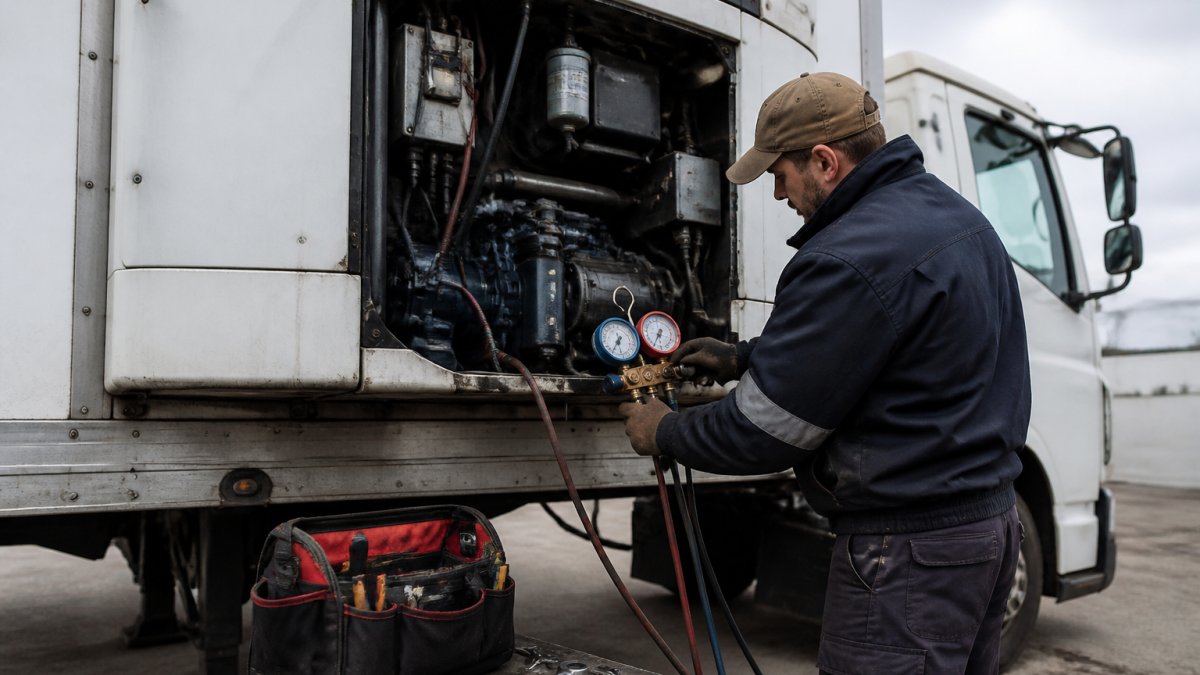
If a reefer unit fails mid-route, fast repair protects the load, and our 24/7 emergency reefer repair team can respond around the clock.
Watch out: releasing product on the assumption that "it was probably fine" without a documented stability assessment is the most common audit finding in excursion handling. If the assessment is not written down, treat the product as not released.
Your Pharmaceutical Cold Chain Compliance Checklist
Use this checklist for every shipment. It covers the gap most carriers miss: handoff accountability.
Product range confirmed against label
Packaging qualified for lane and season
Vehicle pre-cooled and setpoint logged
Two more habits matter. First, plan for seasonal risk: a summer lane needs different packaging than a winter one. Second, build in system redundancy, such as a backup plan for a failed unit or a backup generator at the dock.
Plan Your Next Shipment with a Refrigeration Partner
Compliance holds together only when the equipment holds together.
At Platinum Transport Refrigeration Services, we provide 24-hour emergency mobile repair and maintenance for commercial transport refrigeration units.
Check our reefer repair service area to confirm coverage, then call (509) 547-5262 to schedule service or an emergency response.
Cold chain compliance fails quietly, usually through a missed calibration or an unsigned handoff.
Frequently Asked Questions
What temperature should pharmaceutical products be shipped at?
It depends on the product. Most refrigerated pharmaceuticals ship at 2 to 8 degrees Celsius (36 to 46 degrees Fahrenheit), while controlled room temperature products ship at 20 to 25 degrees Celsius (68 to 77 degrees Fahrenheit). Some biologics and vaccines require frozen or ultracold conditions. Always confirm the labeled storage range on the product and set your shipping and monitoring thresholds around that range before the shipment leaves the dock.
What should you do if a pharmaceutical shipment has a temperature excursion?
Quarantine the shipment immediately and do not release it for use. Pull the data logger records, note the highest and lowest temperatures reached, and record how long the product sat outside its range. Temperature excursion management for pharmaceuticals depends on the product's stability data, so the final call on whether to release, relabel or destroy the product should come from quality assurance, not the carrier.
What records are needed to document pharmaceutical cold chain compliance?
Keep four sets of records: packaging qualification reports, vehicle qualification records, continuous temperature data from every shipment, and signed chain-of-custody forms at each handoff. Add calibration certificates for every monitoring device and a written corrective action log for any excursion. Audit-ready records should be retrievable by shipment date and lot number, and retained per your quality system's requirements so an auditor can trace any shipment from dock to delivery.
How often should temperature monitoring devices be calibrated?
Most quality systems calibrate temperature sensors and data loggers annually against a traceable standard, with a check after any drop, damage or reading that looks off. Some programs calibrate every six months for ultracold or high-value lanes. Whatever interval you choose, document it in your procedures and keep the certificates on file. An uncalibrated logger weakens every record it produces, which is a common finding in audits and a frequent reason shipments get rejected.
Comments