How Long Does Reefer Repair Take? Real Repair Times
Last Updated: November 28, 2026
Quick Summary
Reefer repair takes 30 minutes to 10 hours of hands-on labor depending on the fault, but total downtime is usually longer once you add arrival, diagnosis, parts sourcing, and cooldown testing. Simple jobs like belts finish in 1.5-2.5 hours, while compressor replacement can keep the trailer down 1-2 days.
Refrigerant leak repair and recharge runs 2-4 hours of labor and 4-8 hours of elapsed downtime.
Parts availability is the biggest factor in reefer repair time; ordered parts mean days, not hours.
Ask for the arrival window and the labor estimate as two separate numbers.
Record fault codes and box temperatures before clearing anything so the technician arrives ready.
Frozen goods are urgent within hours, while dry freight in a reefer can wait for a scheduled slot.
Unit down? Know your repair window.
24-hour mobile reefer repair with dealer-level techs and parts on the truck.
Table of Contents
How long does reefer repair take?
Repair labor time varies widely by fault, and the total time your trailer sits idle is usually longer than the hands-on work.
That gap between labor time and downtime is where estimates mislead: a shop quotes two hours, your truck is down for eight.
Below, we break down reefer repair time by repair type, explain why diagnosis can take as long as the fix, and show what you can do while you wait.
Reefer repair time by repair type
Repair time depends heavily on what failed. A thermostat is a quick job; a compressor is not. The table below shows typical labor windows for common failures on a trailer refrigeration unit, plus the elapsed time once you account for diagnosis, parts, and cooldown testing.
Repair Type | Typical Hands-On Labor | Typical Elapsed Downtime | Why It Takes That Long |
Belt replacement | 30-60 minutes | 1.5-2.5 hours | Easy access, single part, short verification run |
Sensor or thermostat swap | 45-90 minutes | 2-3 hours | Fault code check, part swap, reset, and temperature pull-down check |
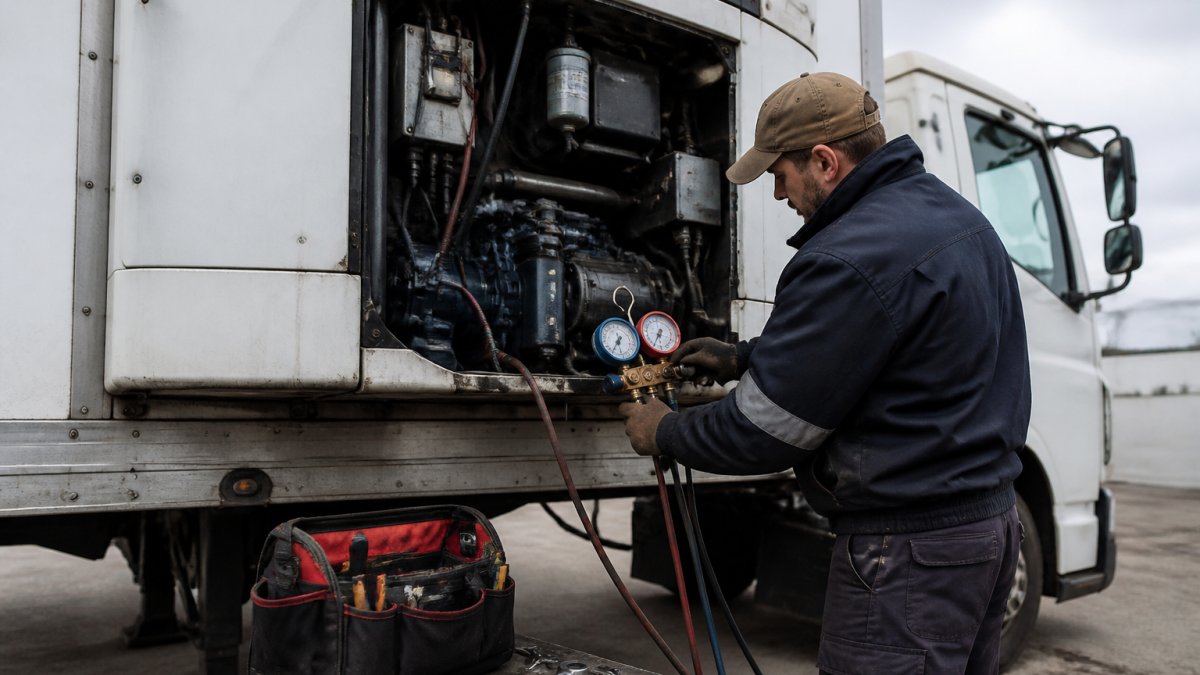
Refrigerant leak repair and recharge | 2-4 hours | 4-8 hours | Leak detection, evacuation, recharge, and stabilization |
Evaporator or condenser work | 3-5 hours | 6-10 hours | Component access, circuit opening, recharge, and system testing |
Compressor replacement | 6-10 hours | 1-2 days | Major teardown, refrigerant recovery, recharge, and full cooldown test |
Electrical fault tracing | 1-4 hours | 2-6 hours | Depends on how deep the fault runs and whether it is intermittent |
Labor is wrench time; elapsed is what your dispatcher should put on the board. Arrival, diagnosis, parts sourcing, and cooldown testing sit between the two.
Matching the symptom to the likely repair
Searchers usually arrive with a symptom, not a repair name. Use this symptom map to set expectations before the technician is on site.
Symptom You See | Likely Repair | Hands-On Time | Common Delay |
Unit will not start | Battery, fuse, or start relay | 30-90 minutes | Low if parts are on the truck |
Alarm code for low pressure | Sensor, Schrader valve, or slow leak | 1-4 hours | Leak tracing can double the time |
Box temperature drifting warm | Refrigerant charge, evaporator fan, or door seal | 1-3 hours | Cooldown verification adds an hour |
Unit runs but does not cool | Compressor, expansion valve, or condenser airflow | 3-8 hours | Parts sourcing is the main variable |
Short cycling | Thermostat, pressure switch, or control board | 1-3 hours | Intermittent faults resist diagnosis |
Loud or squealing noise | Belt, bearing, or fan clutch | 30-90 minutes | Access to the fan drive can add setup time |
Fault code that clears itself | Wiring harness, ground, or sensor | 1-4 hours | Intermittent faults may need a loaded run to reproduce |
A fault code does not point to a simple fix. A low-pressure alarm can mean a bad sensor or a slow leak, and the two can take very different amounts of time to fix. Diagnosis sets the final number.
Simple repairs versus complex repairs
A simple repair covers anything a technician can finish with hand tools and a part already on the truck: belts, sensors, thermostats, and minor electrical connections.
A complex repair involves opening the refrigeration circuit or pulling major components. Compressor, evaporator, and condenser jobs need refrigerant recovery, replacement, recharge, and a full cooldown test before the unit goes back in service.
The line matters for scheduling. Simple repairs often fit a loading window.
Reefer unit diagnostic time: why finding the fault takes as long as the fix
Diagnostic time is the step most drivers underestimate. A reefer unit can throw a fault code for a dozen reasons, and the code tells you the symptom, not the cause.
On-site diagnosis can take a while, and intermittent faults often take longer because the unit must run under load to reproduce them.
Technician familiarity with a unit's control system can affect how quickly a fault is narrowed down.
Factors that change how long a reefer repair takes
Several things move the clock, and most are outside the technician's control.
Technician expertise is second.
Weather and access matter too. A unit parked tight against a dock wall is harder to work on than one with room to open the panels.
For a deeper look at how parts availability drives repair timelines, see our guide on reefer unit repair parts availability.
Parts availability and technician expertise
When you call a provider, ask what parts they carry on the truck, since parts availability has a large effect on repair time.
On-site versus mobile repair and technician arrival time
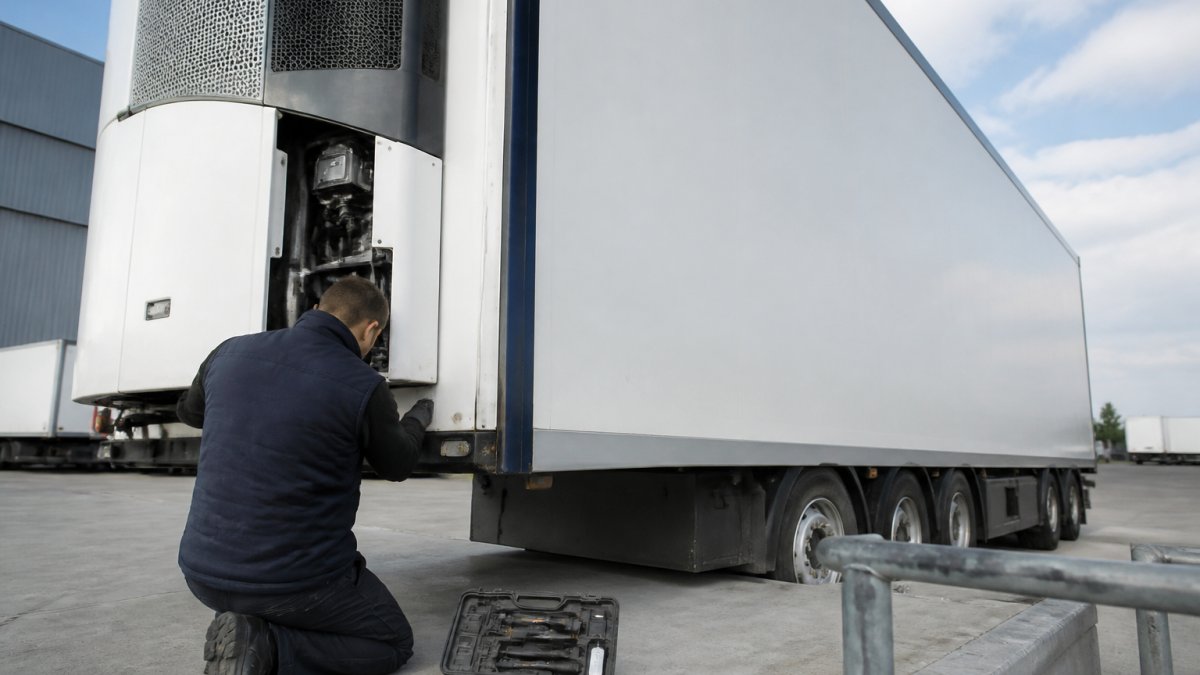
Separate arrival time from repair time. Mobile repair brings the tech to your trailer, so you skip the drive to a depot. But arrival still takes time, especially when your fleet is spread across several locations.
On-site repair at your yard is fastest when the unit is already parked. Mobile repair wins when the trailer is stranded or loaded and cannot move.
Reefer repair downtime costs and what cargo temperature means for urgency
Downtime cost is not just the repair bill. It is the load in the trailer. A reefer that is not cooling puts cargo temperature at risk, and the clock starts the moment the unit fails.
Urgency scales with the cargo:
Frozen goods: hours matter, not days
Fresh produce: a short window before quality drops
Pharmaceuticals: tightest tolerance of all
A trailer full of ice cream and a trailer of canned goods both need repair. Only one is an emergency. Tell the dispatcher what is inside.
For the full cost picture, read our breakdown of downtime impact on the cold chain.
How to reduce refrigerated transport downtime
Downtime shrinks when you plan for failure instead of reacting to it. Preventive maintenance catches belts, sensors, and refrigerant issues before they strand a loaded trailer.
Practical steps that work:
Schedule inspections on a fixed interval, not when something breaks
Log every fault code and alarm, even cleared ones
Replace belts and filters on a set schedule
The last one is underrated. A driver who reports a slow cooldown gets a scheduled repair. A driver who waits until the alarm sounds gets an emergency. For a fuller list of tactics, see seven ways to reduce refrigerated transport downtime.
What to do while you wait for a technician
Protect the cargo first, then protect the evidence. A driver who resets breakers and clears codes before writing anything down hands the technician a unit with no fault history and a load that has already warmed.

Triage the load before you touch the unit
Urgency scales with what is inside the trailer, not with how loud the alarm is. Use the cargo to decide how hard to push for priority service.
Frozen goods: hours matter, not days. Keep doors closed and do not open the trailer to "check" the load, every door opening dumps cold air.
Fresh produce: a short window before quality drops. Note the box temperature at failure and again every 30 minutes.
Pharmaceuticals: tightest tolerance of all. If the load is temperature-sensitive, tell the dispatcher immediately and ask whether a reefer swap or cold storage dock is faster than a repair.
A trailer full of ice cream and a trailer of canned goods both need repair. Only one is an emergency. Tell the dispatcher what is inside. It changes how fast the unit gets prioritized and how the repair is scheduled.
Document the failure so the technician arrives ready
A technician who knows the fault code, the box temperature at failure, and how long the unit has been down can often load the right part before leaving the shop, the difference between a one-visit repair and a parts-order delay.
Record the fault code and any alarms before they clear. Photograph the control panel display.
Note the time the unit failed and the box temperature at that moment, then again every 30 minutes.
Write down what the unit was doing, running, short cycling, off, or making noise, and whether the failure happened under load or at idle.
Tell the dispatcher what cargo is inside and its temperature tolerance.
Confirm the arrival window and labor estimate as two separate numbers.
Keep the unit accessible: pull the trailer away from a dock wall, open the panel access, and clear space around the condensing unit.
Watch out: clearing codes or cycling the main breaker to "see if it resets" wipes the fault history the technician needs to diagnose an intermittent electrical fault, write the code down first, then leave the unit alone.
Protect the load mechanically
Close the trailer doors and confirm whether the unit is actually off or running.
If a swap is not available, keep the doors closed, park in shade if ambient temperature is high, and do not run the unit on a suspect circuit.
If you need fast service, our guide on getting 24 hour reefer repair quickly walks through the call.
Book mobile reefer repair before the unit fails
The best time to line up repair support is before you need it. A failed unit at 2 AM with a loaded trailer is the worst time to compare providers.
Platinum Transport Refrigeration Services offers 24-hour emergency mobile repair and maintenance for commercial transport refrigeration units in the Tri-Cities.
When a unit goes down, call (509) 547-5262 and tell us the fault code and the cargo.
Reefer repair time comes down to three things: what failed, whether the part is on the truck, and how fast a qualified tech can reach you. Line up that support before the next breakdown, and a bad afternoon stays a bad afternoon instead of a lost load. Get started with Platinum Transport Refrigeration Services and keep your fleet cooling, loaded, and on schedule.
Frequently Asked Questions
Can a reefer unit be repaired the same day?
Sometimes. Whether a repair can be finished the same day depends on the fault and on whether the needed part is available. Compressor or evaporator replacements and repairs tied to a backordered part can push the job into the next day. Ask a provider what parts they carry on the truck to understand how likely a same-day repair is.
What factors affect how long reefer repairs take?
Four factors dominate: the fault itself, parts availability, technician expertise, and access to the unit. A fault code that points straight to a failed sensor is quick; an intermittent alarm that only appears under load takes longer to reproduce. If the replacement part is on the truck, labor time is the only clock running. If it has to be ordered, add shipping time. Dealer-level technicians cut diagnosis time because they know the platform. Units parked in tight spots or loaded trailers also slow access.
How long does it take to diagnose a reefer unit problem?
Diagnosis time depends on the fault. A clear fault code can be quick to trace, while intermittent or multi-system problems can take longer. The technician pulls fault codes, tests the refrigeration circuit, checks electrical connections, and confirms the fix under load. A unit that is not cooling but shows no code often takes the longest, because the cause may sit in the refrigerant charge, a sensor, or the compressor.
What should I do while waiting for reefer repair?
Keep the trailer doors closed and monitor cargo temperature so you have a record of conditions. Note the fault codes and alarms on the controller and when they appeared, since that shortens diagnostic time. Confirm the technician has your unit's make, model, and symptoms when you call. If the load is temperature-critical, tell the dispatcher so the job is prioritized. Avoid cycling the unit on and off repeatedly; that can mask the fault or cause further damage before the technician arrives.
Comments