How to Diagnose a Reefer Unit That Will Not Start
Last Updated: November 26, 2026
Quick Summary
A reefer unit that will not start usually has one of three problems: no power reaches the unit, the starter does not crank the engine, or the engine cranks but never fires. Sort the symptom first, then check the battery and fuses, the starter wiring, and the fuel system in that order. Stop at the first fault you find.
Sort the no-start symptom into no power, no-crank, or crank-but-no-start before testing anything
A healthy 12-volt battery reads close to 12.6 volts or higher at rest
Do not crank a crank-but-no-start unit for more than 10 to 15 seconds at a time
Record fault codes, time, mode and repeat behavior before clearing them
Call a technician if checks fail and codes point to the compressor or control board
Is your reefer down right now?
Platinum Transport Refrigeration Services offers 24-hour mobile reefer repair across Washington and Oregon.
Table of Contents
How do I diagnose a reefer unit that will not start?
A reefer unit that will not start usually has one of three problems: no power reaches the unit, the starter does not crank the engine, or the engine cranks but never fires. Each symptom points to a different set of checks, so sorting the problem first saves time. Work through the steps below in order, and stop when you find the fault.
A calm, ordered approach helps. Start with the simple checks, then move to the electrical and fuel systems. Call a qualified technician if the problem is beyond what you can safely test.
Reefer unit is the refrigeration system mounted on a trailer or truck body that keeps cargo at a set temperature. Most units run on a diesel engine that drives the compressor, and many also draw power from an electric standby source when parked at a dock.
Confirm the unit is set to the correct mode and setpoint
Check the fuel level before anything else
Note any alarm or fault code shown on the display
Safety Precautions Before You Start Testing
Safety comes first. A reefer unit can start without warning, and its engine, fan and electrical system all carry real hazards. Before you touch anything, shut the unit off, set the parking brake, and chock the wheels if the trailer is not secured.

Disconnect the standby power cord before working on the unit. Then make sure the engine is cool enough to handle. Wear safety glasses and gloves, and keep loose clothing and jewelry away from belts and fans.
Watch out: Never bypass a safety switch or jumper a fuse to force a start. This can damage the unit and create a fire risk.
Turn off the unit and remove the key or disable the start circuit
Disconnect standby power before opening any electrical panel
Keep a fire extinguisher within reach when working near fuel lines
Step 1: Separate No Power, No-Crank and Crank-But-No-Start Symptoms
Most no-start reefer complaints collapse into one of three symptom families, and each family sends you to a different part of the unit. Sorting the symptom before you open a panel is the single biggest time-saver in reefer diagnosis, because it stops you from testing the fuel system on a unit that never had electrical power to begin with. Use the decision tree below in order and stop at the first branch that matches what you see.
Branch A, No power. The controller display is dark, the key switch produces no response, and no relays click. This is an electrical supply problem upstream of the controller.
Branch B, No-crank. The display lights up and the controller accepts the start command, but the engine does not turn over. You may hear a single click, a rapid chatter, or nothing at all.
Branch C, Crank-but-no-start. The starter spins the engine at normal speed but the engine never fires or fires and dies immediately.
A quick way to confirm the branch: have a second person watch the display and listen at the engine while you turn the key.
Watch out: Do not keep cranking a crank-but-no-start unit for more than about 10 to 15 seconds at a time.
If the symptom changes between attempts, for example, it cranks one time and is dead the next, treat it as an intermittent electrical fault and go to the cold-weather and intermittent section before replacing any parts.
Step 2: Check Battery, Charging System and Fuses
Low battery voltage is one of the most common causes of a no-start. Measure the battery voltage with the unit off. A healthy 12-volt battery reads close to 12.6 volts or higher at rest. A reading well below that suggests a weak or dead battery.
Next, check the charging system. With the engine running, the alternator should hold the battery near 13.5 to 14.5 volts. A lower reading means the alternator or its wiring may be failing.
Inspect the main fuse and the microprocessor fuse. Look for a blown fuse or a loose fuse holder. Clean any corroded terminals, because a poor connection can look like a dead battery.
A weak battery is a common root cause, so test the battery before you replace the starter. Our guide to signs your transport refrigeration needs service explains which symptoms point to routine service.
Why a Reefer Unit Won't Crank: Starter and Wiring Checks
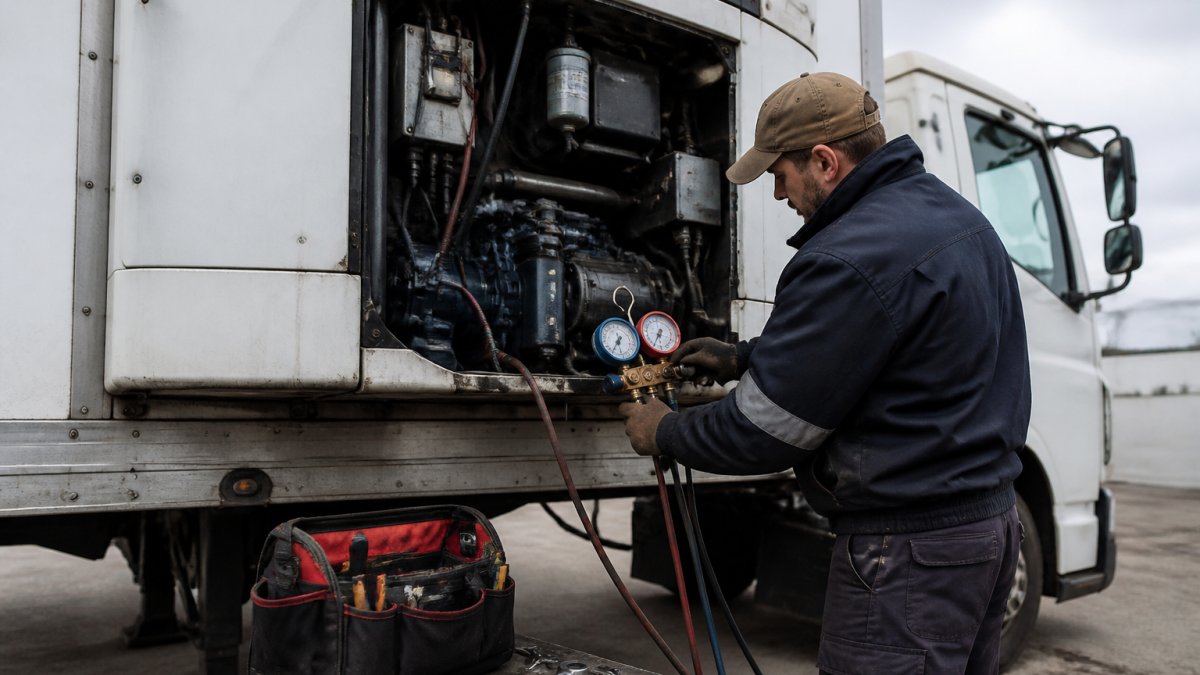
If the unit is silent or only clicks when you turn the key, the starter circuit is the likely culprit. A starter that clicks often means the battery is not delivering enough current. Recheck the battery connections first, then test the starter.
Look for a shorted wire or a damaged ground connection. A ground connection that has corroded or loosened can block current flow even when the battery is fully charged. Clean and tighten every ground point you can reach.
Watch out: Do not jump-start a reefer from a vehicle with a different voltage system. Confirm the voltage before connecting any booster source.
Clean battery terminals and ground straps
Look for chafed or pinched wires near the starter
Test the starter only after confirming good battery voltage
Reading Carrier and Thermo King Fault Codes and Alarms
Modern reefer controllers are a useful diagnostic tool on the unit, but only if you capture the code correctly and interpret it against the right manual. Treat the display as a starting point, not a verdict.
Capture before you clear. The moment a code appears, record four things: the code number or alarm text exactly as displayed, the time and date, the operating mode the unit was in (startup, pull-down, setpoint, defrost, electric standby), and whether the code repeats after a restart. Clearing codes without recording them erases the freeze-frame history a technician needs to diagnose an intermittent fault. A phone photo of the display is the fastest reliable record.
Interpret in layers. Read the code meaning in the service manual for your exact model and controller, then ask three questions. First, is the code a direct sensor fault or a system-level fault? Second, is the code an active shutdown or a stored warning? Third, does the code clear and return immediately, or only after the unit warms up or cools down?
Use the code to route, not to replace. A code that points to a fuel solenoid, for example, tells you to test the solenoid circuit, power at the coil, ground integrity, and coil resistance, before condemning the solenoid.
Escalate on these codes. Stop troubleshooting and call a qualified technician if the code points to the compressor, the control board or microprocessor, the oil pressure sensor or oil pressure shutdown, or any high-voltage electric-standby fault. These systems require model-specific tools and safety procedures, and repeated start attempts on a unit with an active shutdown can cause secondary damage.
Record code, time, mode, and repeat behavior before clearing anything
Look up the code in the manual for your exact model and controller version
Test the circuit the code points to before replacing the component
Escalate compressor, control board, oil pressure, and high-voltage faults
Watch out: Do not clear codes to 'see if it starts' on a unit that is under warranty or a service contract. Cleared history can void diagnostic coverage and makes an intermittent fault far harder to find.
Reefer Fuel System Troubleshooting: Fuel Level, Filters and Pump
A fuel problem is a common reason a unit cranks but never runs. Start with the simplest check: confirm the tank has enough fuel. Then look for air or water in the fuel system, which can stop the engine from firing.
Check the fuel filter and the prestrainer for clogs or water contamination. A clogged filter restricts flow and starves the engine. Replacing a dirty filter is a quick and inexpensive fix that often solves the problem.
Listen for the fuel pump when you turn the unit on. A pump that does not run may have a fuse, relay, or wiring fault, or the pump itself may have failed.
Confirm the fuel level and look for water in the fuel
Inspect and replace a clogged fuel filter or prestrainer
Check fuel pump power and listen for it running
The article lists three fuel-side checks, in order, to run when a unit cranks but will not start.
Check | What to look for | Action |
Fuel level | Enough fuel in the tank | Confirm level first |
Fuel contamination | Air or water in the fuel | Check for water and air |
Filter and prestrainer | Clogs or water contamination | Replace if dirty |
Fuel pump | Pump runs when unit turns on | Listen for it; check fuse and relay |
When to Call a Technician for Thermo King Reefer Troubleshooting and Fast Mobile Repair
Some problems need a qualified technician. Call for help if you have checked the battery, fuses, wiring and fuel and the unit still will not start. Also call if the fault codes point to the compressor, the control board, or the oil pressure sensor. A Thermo King reefer repair technician can take over once your diagnosis points to a mobile repair.
Do not keep testing a unit with an unknown high-voltage or fuel-system fault. Repeated attempts can cause more damage and extend the downtime. Check whether we cover your location in our reefer repair service area before you call.
For a fast response, Platinum Transport Refrigeration Services offers 24-hour emergency mobile repair for commercial reefer units in the Tri-Cities area. Owners of Carrier units can request the same mobile service. Our technicians carry a large variety of parts on-site.
To reach us anytime, call (509) 547-5262.
Frequently Asked Questions
Why is my reefer not starting?
The most common causes are a weak or dead battery, a blown main or microprocessor fuse, loose or corroded battery and ground connections, low fuel, or a fuel delivery problem such as a clogged filter or failing fuel pump. Start by confirming whether the unit has power at the control panel. If the display is dead, focus on the battery, fuses and wiring. If the display lights but the engine cranks without firing, check fuel level, fuel filters and the operating mode settings. Fault codes shown on the controller often narrow the cause quickly and should be recorded before you clear anything.
Can you jump-start a reefer unit?
Jump-starting is sometimes possible when the battery is the only problem, but it should be done carefully and only after confirming the unit's engine and electrical system are otherwise healthy. Connect jumper cables to the correct battery terminals, follow the manufacturer's sequence, and never jump a unit that shows a charging system fault, since that can damage electronics. If the battery will not hold a charge after a jump, the charging system or battery needs replacement and a technician should inspect it.
What does it mean if a reefer unit clicks but will not crank?
A clicking sound with no cranking usually points to a low battery voltage, a poor battery connection, or a faulty starter solenoid or starter motor. Measure battery voltage with the unit off and then while attempting to start. A large voltage drop during cranking suggests a weak battery or high-resistance connections. Inspect cable ends and ground straps for corrosion before replacing parts, and verify that the starter circuit fuse is intact.
When should I call a reefer technician for a no-start problem?
Call a qualified technician if the unit has no power after checking the battery and fuses, if fault codes persist after basic checks, if you smell fuel or burning wiring, or if the fuel system tests as healthy but the unit still will not run. Cargo temperature risk rises quickly, so escalate early when perishable or pharmaceutical loads are aboard. Platinum Transport Refrigeration Services provides 24-hour mobile diagnostics and repair; for current service rates or a quote, contact us at (509) 547-5262.
Comments