Impact of Downtime on Cold Chain: Costs & Prevention
Last Updated: October 24, 2026
Quick Summary
The impact of downtime on cold chain shows up as temperature drift that raises food safety risk and shortens shelf life, with losses compounding the longer a unit stays down. A 30-minute outage caught by remote monitoring is usually a repair bill, while an overnight failure on a full load is often a total loss plus a customer relationship.
Cold chain downtime is any period when temperature-controlled equipment stops maintaining its setpoint during storage or transport.
Product category drives exposure: vaccines and biologics carry the tightest recovery time objectives because potency loss is irreversible.
Preventive maintenance catches failures before they strand a load, and reactive repairs always cost more than planned ones.
The first 30 minutes call for detecting the alert, triaging the cause, protecting the product, and notifying the chain.
Track mean time to repair, time to detection, excursion duration, and spoilage rate monthly, not annually.
Table of Contents
How Cold Chain Downtime Erodes Food Safety and Product Quality
The Cost of Cold Chain Failure: Quantifying Financial Losses
Primary Causes of Cold Chain Disruption: Power Outages, Equipment Failures, and Human Error
Transport Refrigeration Unit Maintenance: Preventing Downtime Before It Starts
FDA Food Safety Modernization Act Cold Chain Requirements and Compliance Risks
Vaccines, Biologics, and Medical Supplies: When Downtime Becomes a Health Risk
Building a Downtime Response Playbook and Business Continuity Plan
How Cold Chain Downtime Erodes Food Safety and Product Quality
The impact of downtime on cold chain performance shows up long before a load is condemned.

Cold chain downtime is any period when temperature-controlled equipment stops maintaining its setpoint during storage or transport. The damage compounds in two directions: food safety risk and product quality loss.
Temperature variation is the quiet culprit.
The USDA Food Safety and Inspection Service guidance on temperature control is blunt about this: keeping product out of the danger zone is not optional, and time spent there cannot be reversed by re-cooling.
What most operators miss is that quality loss is often invisible at delivery.
The Cost of Cold Chain Failure: Quantifying Financial Losses
The cost of cold chain failure rarely appears as one line item. It spreads across spoiled inventory, rejected shipments, emergency freight, overtime labor, and lost contracts. The true impact of downtime on cold chain depends on three variables: how long the unit was down, how far temperature drifted, and what was in the box. Build your loss model around those three inputs.
A duration-based loss model
Downtime losses compound rather than scale linearly. A 30-minute outage caught by remote monitoring is usually a repair bill; a four-hour outage on a loaded trailer is a partial loss; an overnight failure on a full load is often a total loss plus a customer relationship.
A practical way to model it is to estimate loss as a percentage of load value across duration bands, then calibrate the bands to your own product mix and equipment. A common pattern practitioners use looks like this:
Outage duration | Typical exposure | Approximate loss band (share of load value) |
Under 30 minutes, caught by alert | Minimal drift | Repair cost only |
30 minutes to 2 hours | Partial excursion | Low single-digit percent |
2 to 6 hours | Sustained excursion | Double-digit percent |
6 to 12 hours (overnight) | Full excursion | High double-digit percent to total loss |
Over 12 hours | Condemned or compromised | Total loss plus disposal and rejection costs |
Treat the bands as a starting framework, not a published statistic. Calibrate them against your incident history, product thermal profiles, and customer rejection records.
Cost varies sharply by product category
Not every pallet loses value at the same rate. Product category determines both thermal tolerance and financial exposure:
Leafy greens, berries, and fresh produce. High surface-area-to-mass ratio means fast drift and short shelf life; losses show up as shortened marketable days even when the load passes a spot check.
Dairy and eggs. Moderate thermal mass but tight customer specifications; a load arriving a few degrees warm may be accepted and still fail a buyer audit later.
Meat and poultry. The danger zone above 40°F accelerates pathogen growth, so the loss is often a food safety and compliance problem, not just a quality one. Condemnation and disposal costs add to the inventory loss.
The full cost stack
Product loss is usually the largest single hit, but rarely the whole bill. A complete estimate should count:
Cost Category | What to Count | Why It Matters |
Product loss | Full value of condemned freight | Often the largest single hit |
Disposal and destruction | Rendering, landfill, or regulated disposal fees | Frequently overlooked |
Rejected shipments | Refused loads plus return freight | Doubles the loss on one load |
Emergency response | After-hours repair call, rush parts, premium freight | Predictable and avoidable |
Idle labor | Driver and dock hours waiting | Invisible until payroll runs |
Customer credits | Discounts to retain accounts | Erodes margin quietly |
Contract risk | Volume penalties, lost bids, chargebacks | Longest-lasting damage |
Financial losses scale with duration, and operating costs rise too: reactive repairs and emergency parts cost more than planned maintenance. The cheapest dollar you spend is the one that prevents the outage.
Watch Out The most expensive downtime is the kind you discover at delivery. Without real-time alerts, a unit that failed at 11 PM may run warm for eight hours before anyone notices, turning a repairable fault into a total product loss plus disposal fees and a rejected shipment.
Primary Causes of Cold Chain Disruption: Power Outages, Equipment Failures, and Human Error
Disruptions trace back to three families of causes, each demanding a different defense. Knowing which one hits you most often is the first step toward reducing the impact of downtime on cold chain operations.
1. Power outages and electrical faults. Facility power loss, tripped breakers, and shore power failures at docks all stop refrigeration cold.
2. Equipment failure and malfunction. Compressor failure, refrigerant leaks, fan motor burnout, and control board faults are the classic breakdowns.
3. Human error and process failures. Doors left open, setpoints entered wrong, pre-cooling skipped, and units shut off to save fuel all cause avoidable excursions.
For deeper troubleshooting on specific units, our blog covers maintenance insights worth bookmarking.
Transport Refrigeration Unit Maintenance: Preventing Downtime Before It Starts
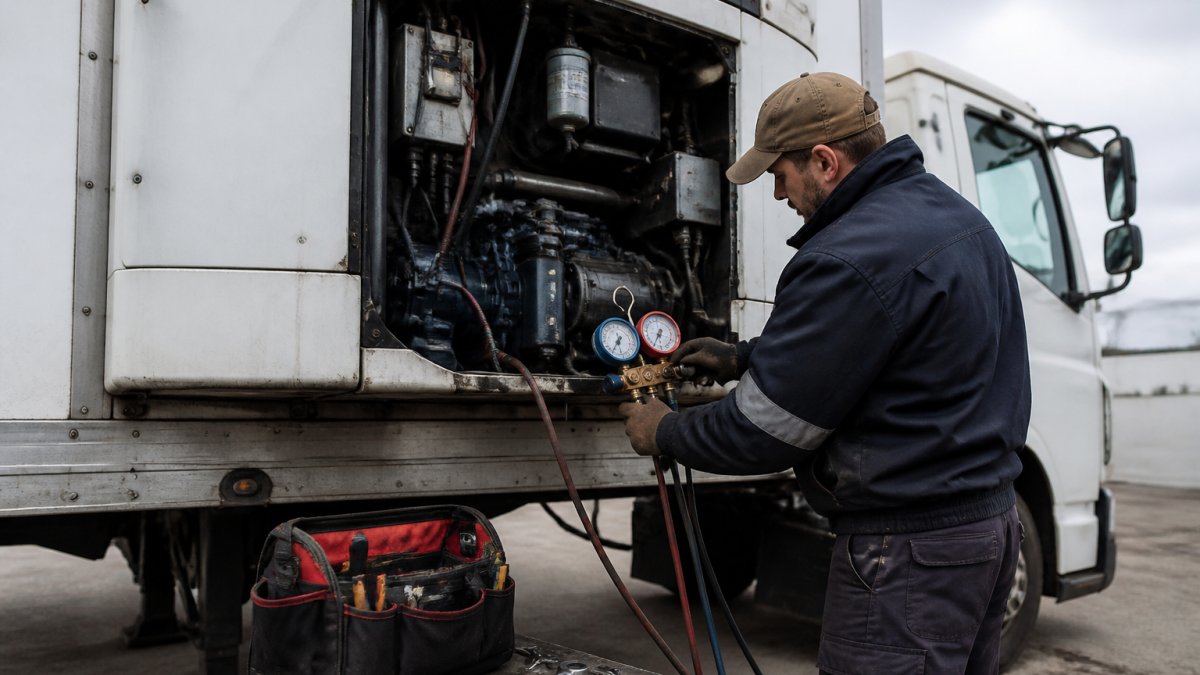
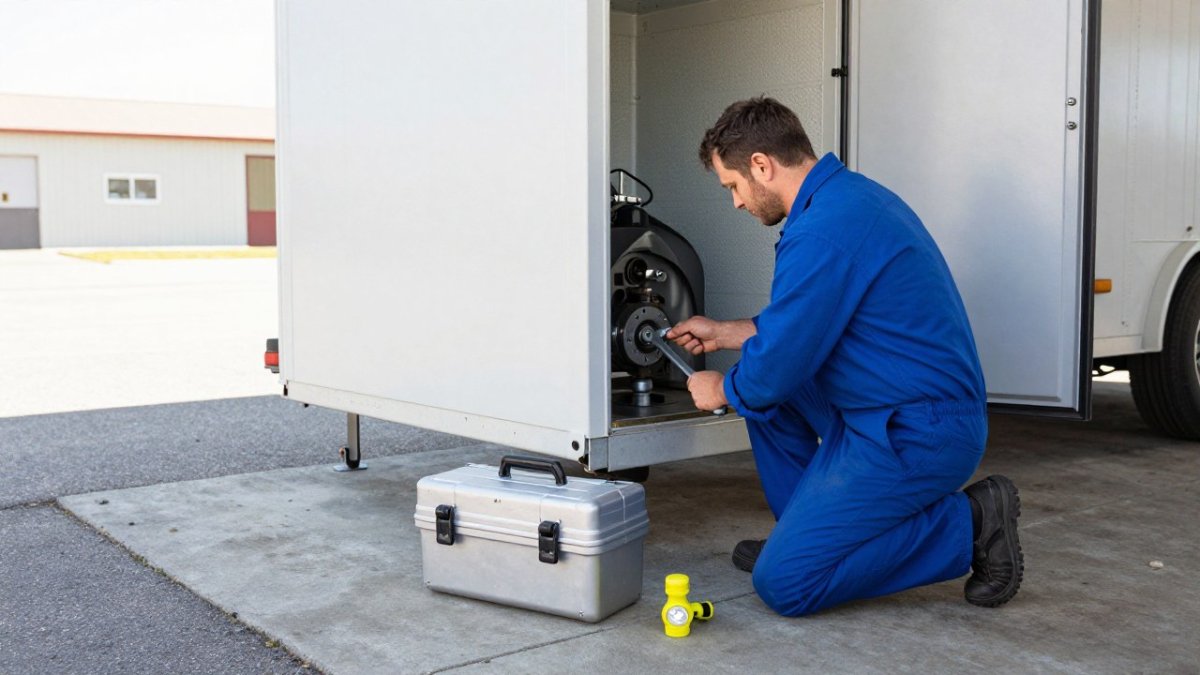
Preventive maintenance is the highest-return investment in cold chain reliability. Transport refrigeration unit maintenance catches failures before they strand a load, and reactive repairs always cost more than planned ones.
A workable maintenance rhythm looks like this:
Inspect refrigerant levels and check for leaks every service interval
Test defrost cycles and door seals monthly
Clean condenser coils to prevent overheating under load
Predictive maintenance goes further. Monitoring data reveals trends, like slowly rising pull-down times, that signal a failing component weeks before breakdown. Act on that data instead of waiting for a fault code.
Pro Tip Track pull-down time on every unit. When a reefer takes noticeably longer to reach setpoint than it did last quarter, the compressor or refrigerant charge is telling you something. Catching that trend early is far cheaper than a mid-route failure.
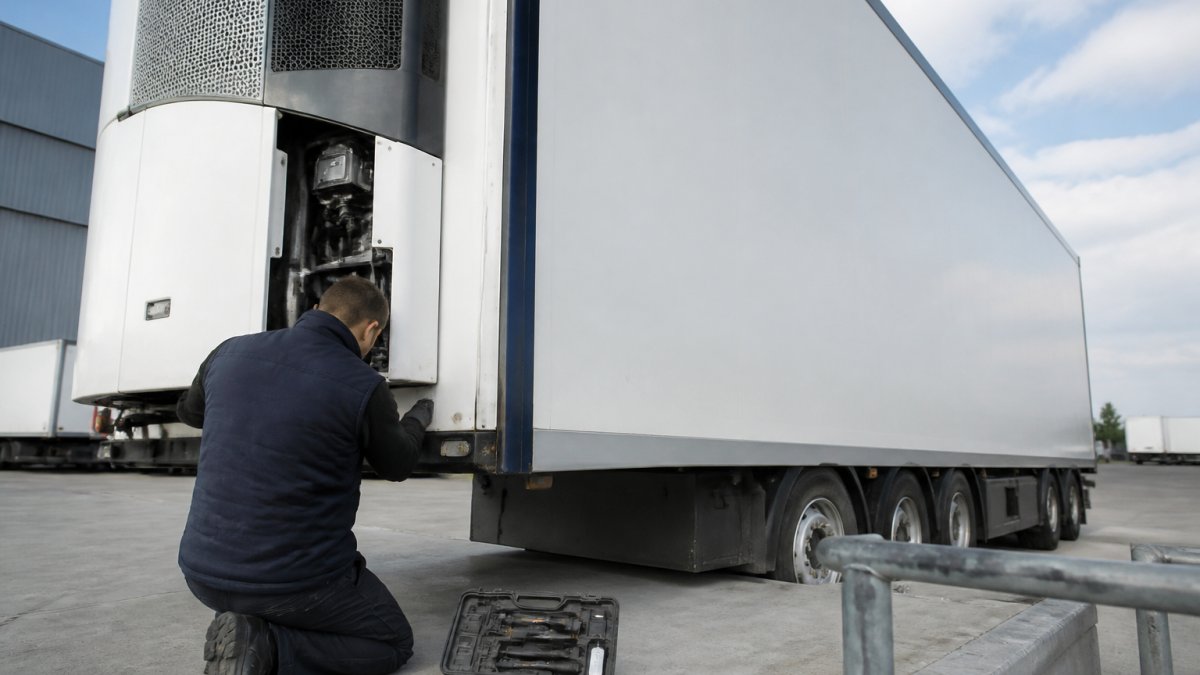
When a unit does fail, fast response matters more than anything else. That's why we run 24-hour emergency mobile repair with dealer-level expertise and parts carried on-site. You can book transport refrigeration service and get a mobile unit to your location.
FDA Food Safety Modernization Act Cold Chain Requirements and Compliance Risks
Compliance is where downtime stops being a cost problem and becomes a legal one.
Under the FDA's Sanitary Transportation of Human and Animal Food rule, businesses must demonstrate that temperature control was maintained throughout transit.
The compliance risks of downtime include:
Failed temperature records that trigger audit findings
Product disposition decisions made without documentation
Repeat violations that invite closer regulatory scrutiny
Temperature excursion assessment matters here. When a unit fails, document how long product was exposed, at what temperature, and what you did about it. That record protects you in an audit and guides disposition.
Vaccines, Biologics, and Medical Supplies: When Downtime Becomes a Health Risk
Medical cold chain failures carry consequences no insurance policy covers.
The CDC Vaccine Storage and Handling Toolkit sets strict expectations for temperature monitoring and excursion response. Medical supplies like insulin, blood products, and certain biologics demand the same discipline.
When downtime hits a pharmaceutical load, the response playbook differs from food:
Quarantine the load immediately and document the excursion window
Consult the manufacturer's stability data before any disposition decision
Never assume a re-cooled product is safe to release
Loss of potency is often irreversible. That's why backup infrastructure and remote monitoring with real-time alerts are non-negotiable for anyone hauling medical freight.
Building a Downtime Response Playbook and Business Continuity Plan
A response playbook turns panic into process. The impact of downtime on cold chain shrinks when everyone knows their role before the alarm sounds. The difference between a plan that works and a binder on a shelf is specificity: named roles, defined time targets, and pre-made decisions for the first minutes and hours after a failure.
Start with recovery time objectives
A recovery time objective (RTO) is the maximum time a product category can be exposed before it must be stabilized, moved, or condemned. Define RTOs by product, not fleet.
Work backward from each RTO to the equipment, contacts, and authority needed to hit it. If a vaccine load must be stabilized within 30 minutes, you need standby storage within that radius, a named decision-maker on call, and a repair partner who answers at 2 AM.
The first 30 minutes
Detect and confirm. Remote monitoring triggers an alert the moment temperature drifts. Confirm the alert is real and not a sensor fault, a failed sensor can look identical to a failed unit, and the response differs.
Triage the cause. Determine whether it is power, equipment, or human error. Power failures call for generator or shore power; equipment failures call for repair dispatch; human error calls for correcting a setpoint or door state.
Protect the product. Close doors, stop loading, and avoid opening the trailer. Every door opening accelerates the drift.
Notify the chain. Alert the shipper, receiver, and carrier contact per the contract. Early notification preserves options and documentation.
The first 2 to 8 hours
Contain. Move product to backup cold storage or a standby unit if the RTO is at risk. Pre-identify alternate storage within your RTO radius so this is a phone call, not a search.
Repair. Dispatch mobile service with parts on hand. Log the dispatch time, arrival time, and repair completion time, these become your downtime KPIs.
Assess the excursion. Document the exposure window, the temperature range, and the product involved. This record drives disposition and protects you in an audit.
Decide disposition. Quarantine the load and decide whether it can be released, reworked, or discarded. Never assume a re-cooled product is safe to release. For food, follow FDA requirements and the customer's specification; for vaccines and biologics, consult the manufacturer's stability data. Requirements vary by product and jurisdiction, so document the basis for the decision.
Review. Update the plan based on what the incident revealed. A playbook never revised after an incident will fail the same way twice.
Backup infrastructure trade-offs
Business continuity planning means choosing backup infrastructure before you need it. The main options trade cost against recovery speed:
Backup power. Generator capacity sized to your refrigeration load, with scheduled load testing. Generators that are never tested under load are a common failure point.
Redundant refrigeration. Standby compressors or a second unit on critical loads. Higher capital cost, fastest recovery.
Alternate storage. A vetted cold storage partner within your RTO radius. Low cost, but only works if the transfer can happen inside the RTO.
Measure whether the plan works
Downtime KPIs tell you whether the playbook is real. Track mean time to repair, time to detection, excursion duration, spoilage rate as a share of loads, and on-time-in-full performance. Review monthly, not annually, a rising time-to-detection is an early warning that monitoring or staffing has drifted.
Key Takeaway The fleets that recover fastest aren't the ones with the newest equipment. They're the ones with a written playbook, defined recovery time objectives, tested backup power, and a repair partner who answers at 2 AM.
Frequently Asked Questions
What are the primary causes of cold chain downtime?
The most common causes are power outages, refrigeration equipment failure or malfunction, and human error during loading or monitoring. Weather events and supplier issues also contribute. In many operations, aging equipment and skipped transport refrigeration unit maintenance accelerate breakdowns. Real-time monitoring and remote alerts help catch temperature excursions before they become full downtime events.
How does refrigeration failure affect food safety compliance?
Under the FDA Food Safety Modernization Act cold chain requirements, processors and distributors must maintain temperature controls and keep records. A refrigeration failure can lead to temperature excursions that compromise food safety, triggering potential recalls, regulatory scrutiny, and mandatory reporting. Without proper monitoring devices and documentation, a single downtime event can result in compliance violations and financial losses.
What is the financial impact of a broken cold chain?
The cost of cold chain failure includes spoiled product, lost revenue, disposal fees, and potential fines. For high-value perishables or pharmaceuticals, a single prolonged outage can cost tens of thousands of dollars. Downtime also raises operating costs through emergency repairs and overtime. Preventive maintenance and backup power reduce these risks and protect customer satisfaction.
How can real-time monitoring prevent cold chain disruptions?
Real-time monitoring uses sensors and remote alerts to track temperature continuously. When a temperature excursion occurs, alerts notify staff immediately, allowing quick intervention before product spoilage. This data also supports predictive maintenance by flagging equipment reliability issues. Over time, performance data helps identify patterns and prevent future downtime events.
Cold chain downtime is manageable, but only if you treat prevention and response as one system. When a unit fails, you need mobile service that reaches you fast, carries the parts, and knows Thermo King and Carrier systems cold. Platinum Transport Refrigeration Services provides 24-hour emergency mobile repair, dealer-level technical expertise, and on-site parts to keep your fleet running. Call (509) 547-5262 to get your reefer back online.
Comments