Is Your Reefer Unit Burning Too Much Fuel?
Last Updated: November 22, 2026
Quick Summary
Reefer unit fuel efficiency is how much cooling a unit delivers for each gallon of diesel it burns. Measure fuel per engine hour, compare it to the unit's own healthy baseline, and flag any unit running more than 15% above it.
Record fuel at the same point each time and divide gallons used by engine hours.
Flag a unit for diagnosis when it runs more than 15% above its own baseline.
Separate reefer fuel use from tractor fuel use so you know which one is costing you.
Continuous-run mode burns more fuel than start-stop mode, which can cause larger temperature swings.
Clean the air filter and condenser first, since restricted airflow is a cheap and common cause of excess burn.
Is your reefer burning too much fuel?
Platinum Transport Refrigeration Services provides 24/7 mobile reefer repair across Washington and Oregon.
Table of Contents
Reading Reefer Unit Troubleshooting Codes That Signal Efficiency Problems
Reefer Unit Maintenance Checklist for Better Fuel Efficiency
Why Reefer Unit Fuel Efficiency Matters for Your Fleet
A reefer unit that burns more fuel than it should drains your budget every mile. Fleet managers in the Tri-Cities and across Washington often find that abnormal fuel burn is a sign something needs attention.
Reefer unit fuel efficiency is how much cooling a unit delivers for each gallon of diesel it burns. A unit that holds setpoint while using less fuel is working well.
Fuel is also a cargo issue. Tracking fuel gives you an early warning.
Fuel burn rises quickly when a unit is working harder than it should
Small problems, such as a clogged filter, cost more over a long run
Measuring fuel helps you catch a problem before a breakdown
Measuring Reefer Fuel Consumption Per Hour
You cannot manage what you do not measure. The simplest method is to track reefer fuel consumption per hour of runtime. Use the unit's hour meter or engine hours to get the runtime, then divide the fuel used by those hours.
Record fuel at the same point each time. A full tank before and after a fixed period gives the cleanest number. Keep the records by unit so you can compare one trailer against itself over time.
Note the date, the unit ID and the engine hours at each fill-up
Calculate gallons used per hour for each period
Flag any unit that jumps more than 15% above its own baseline
Separating Reefer Unit Fuel Use From Tractor Fuel Use
Many fleets mix the two. The tractor and the reefer often share one fuel tank, so the total fuel number hides the reefer's share. Measure them apart so you know which one is costing you.
Use a separate fuel tank or an auxiliary tank for the reefer where your equipment allows it. If you cannot, track idle time for the tractor and runtime for the reefer, then estimate the split.
Typical Fuel Consumption Benchmarks by Operating Mode
Fuel burn changes with how the unit runs. Continuous-run mode usually burns more fuel than start-stop mode, because the engine never shuts off.
Compare each unit against the manufacturer's published figures for its model. Your own baseline from a healthy period is often the most useful benchmark.
Benchmarks from the article's measurement guidance show how to tell a normal reefer from one that needs attention.
Measure | Value | Note |
Flag threshold | More than 15% above baseline | Compare each unit against its own healthy baseline |
Fuel record | Gallons per engine hour | Record fuel at the same point each time |
Continuous-run mode | Higher fuel burn | Engine never shuts off |
Start-stop mode | Lower fuel burn | Can produce larger temperature swings |
Baseline period | Three to six months | Pull fuel and runtime records for the unit |
Factors That Drive Reefer Unit Fuel Consumption
Several factors push fuel use up. Ambient temperature matters most. A unit works much harder on a hot day in the desert than on a mild day, and that extra work costs fuel.
Ambient temperature and weather: Heat and cold both increase load
Setpoint and cargo temperature: A colder setpoint costs more fuel
Trailer insulation and door seals: Worn seals let cold air escape
Step-by-Step Diagnostic Workflow for Abnormal Fuel Burn
A fuel complaint is only useful if you can turn it into a number and then walk that number back to a cause. The workflow below starts from a measured baseline, moves through the highest-probability causes in order, and tells you where operator checks stop and certified technician work begins. Work the steps in sequence and re-measure after each corrective action so you can prove the fix worked.

Step 1: Establish a measured baseline before you diagnose
Pull three to six months of fuel and runtime records for the specific unit. You want gallons per engine hour, not gallons per trip, because trip length and load vary. If records are thin, run a controlled baseline: fill the reefer tank to the same point, record the hour meter, run a known duty cycle (for example, a loaded pull at a fixed setpoint in similar ambient conditions), refill to the same point, and divide gallons by engine hours.
Flag the unit for diagnosis when it runs more than about 15% above its own healthy baseline under comparable conditions. A single hot week or a heavy defrost cycle can move the number, so confirm the jump across at least two measurement periods before you tear into the unit.
Step 2: Rule out setpoint, load, and ambient conditions
Before touching hardware, confirm the setpoint matches the cargo requirement and that the load was pre-cooled as specified. A unit asked to pull down a warm load in high ambient will burn more fuel legitimately. Note ambient temperature, setpoint, mode (continuous or start-stop), and whether the trailer doors were opened repeatedly. If the abnormal burn disappears once conditions are normalized, you have an operating issue, not a mechanical fault.
Step 3: Check airflow and the air filter
A restricted air filter or a condenser packed with debris forces the unit to run longer to reject heat. Inspect the air filter, clean or replace it, and clear the condenser coil and fan area. This is the cheapest fix on the list and one of the most common causes of creeping fuel burn. Re-measure after cleaning; if gallons per hour drop back toward baseline, you found it.
Step 4: Inspect door seals, insulation, and trailer condition
Cold-air loss makes the unit work harder on every cycle. Check door seals for gaps and tears, look for damaged insulation or a damaged trailer wall, and confirm doors close and latch fully. A trailer that cannot hold temperature will keep a healthy reefer running long after the fuel problem looks like a reefer problem.
Step 5: Review alarm codes and fault history
Write down every active and stored code, the date, and the engine hours when it appeared. Repeated codes matter more than one-time codes, and a code that returns after a reset usually means the underlying fault is still present. Use the code history to sort the problem into one of four buckets: airflow, fuel delivery, refrigeration circuit, or sensor/electrical. That sort tells you which of the next steps to prioritize.
Step 6: Check the fuel system for restrictions
Inspect the fuel filter and drain water from the fuel system per the manufacturer's schedule. A restricted fuel filter or a weak fuel pump can reduce delivery and make the unit run inefficiently or stumble under load. Replace filters as specified and check for air in the fuel system. Fuel-system work beyond filter service and water draining is technician-level on most units.
Step 7: Verify refrigerant charge and refrigeration components
Low refrigerant charge reduces cooling capacity and raises runtime, which shows up as higher fuel per hour. Refrigerant level checks and any work on the refrigeration circuit require certified equipment and training (the EPA). Do not open the circuit yourself. Have a qualified technician confirm charge, check for leaks, and inspect the condenser fan and related components.
Step 8: Re-measure and compare to baseline
After each fix, run the same controlled measurement you used in Step 1 and compare gallons per hour to the baseline under similar ambient and load conditions.
Watch out: Do not reset and clear codes as a first move. Clearing the history erases the pattern that points to the cause, and a code that returns after a reset is telling you the fault is still there.
Operator checks versus technician work
Safe for an operator: recording fuel and engine hours, confirming setpoint and load conditions, inspecting and cleaning the air filter and condenser, checking door seals, reading and recording alarm codes, and servicing the fuel filter and water separator per the manufacturer's schedule. Technician-level: refrigerant charge and leak work, fuel pump and injection-system repair, electrical and sensor diagnosis beyond connector checks, and any repair inside the refrigeration circuit.
Reading Reefer Unit Troubleshooting Codes That Signal Efficiency Problems
Alarm codes are the unit's way of telling you what is wrong. Some codes point straight at fuel and efficiency issues, such as a sensor fault that keeps the unit running longer than needed.
Write down each code, the date, and the unit's runtime when it appeared. Repeated codes matter more than one-time codes.
Some codes you can check safely, such as a loose connector or a dirty sensor. Learn which warning signs mean it is time for professional service.
Reefer Unit Maintenance Checklist for Better Fuel Efficiency
Use this checklist at each service interval:
Replace or clean the air filter
Clean the condenser and remove debris
Inspect the fuel filter and drain water from the fuel system
Routine maintenance is far cheaper than a breakdown on the road. Many fleets find that a steady schedule keeps fuel burn predictable.
Scheduling a Technician for Your Next Reefer Fuel Problem
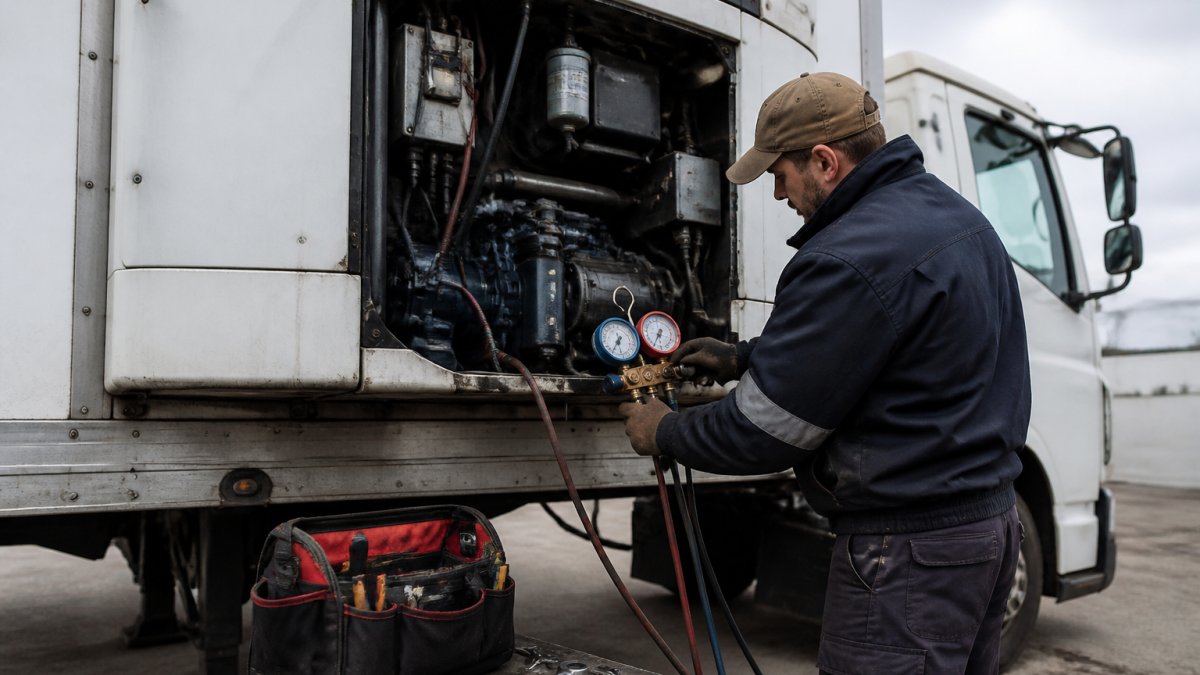
When the checks above do not explain the fuel burn, it is time for a technician. Mobile service is available, so a technician can come to your yard or the roadside. book a mobile reefer repair and we will diagnose the unit where it sits.
If your unit is a Thermo King, schedule Thermo King repair with a technician who services that brand. Before you book, confirm our reefer repair service area covers your location in Kennewick, Pasco, Richland or elsewhere in Washington and Oregon.
Breakdowns rarely wait for business hours. 24-hour emergency reefer repair is available for breakdowns. You can also call us directly at (509) 547-5262.
Platinum Transport Refrigeration Services offers 24-hour emergency mobile repair and maintenance for commercial transport refrigeration units. Call (509) 547-5262 to schedule service.
Frequently Asked Questions
How much fuel should a reefer unit use per hour?
Fuel burn per hour depends on the unit model, engine size, operating mode and load conditions, so there is no single number that fits every fleet. The most reliable benchmark is your own baseline: record fuel consumption per hour on the same route, at the same setpoint and in similar ambient temperatures over several trips. Once you have that baseline, a sustained rise of more than about 10 to 15 percent under comparable conditions is a signal to investigate. Compare against the manufacturer's published fuel data for your specific model, and log engine hours so you can separate reefer runtime from tractor idling.
What causes a reefer unit to burn too much fuel?
The most common causes are a dirty air filter restricting airflow, a clogged fuel filter, low refrigerant charge, a fouled condenser, worn door seals that let cold air escape, and a temperature sensor giving false readings. Each of these forces the unit to run longer or harder to hold setpoint. Operating habits matter too: frequent door openings, setpoints far below what the cargo requires, and running in continuous mode when start-stop would suffice all raise fuel use. Start with the cheapest checks, such as filters and seals, before paying for component diagnosis.
Can a dirty air filter increase reefer fuel consumption?
Yes. A restricted air filter reduces airflow across the condenser and evaporator, so the unit works harder to move the same amount of cold air and burns more fuel to do it. Inspect the filter at every pre-trip and replace it on the interval in your reefer unit maintenance checklist, or sooner in dusty operating environments. Record fuel consumption per hour before and after replacement on the same route to confirm the effect on your specific unit.
When should I call a technician for a reefer unit fuel problem?
Call a qualified technician when fuel burn stays elevated after you have completed the safe checks, when the unit shows alarm codes you cannot clear, when cargo temperature drifts from setpoint, or when you suspect a refrigerant, compressor, fuel-pump or electrical fault. Safe checks such as inspecting filters, seals, airflow paths and logged fuel data are appropriate for drivers and fleet staff. Refrigerant handling, fuel-system repairs and electrical work should be left to trained technicians. Platinum Transport Refrigeration Services offers 24-hour mobile diagnostics and repair across the Tri-Cities; contact the company directly at (509) 547-5262 or visit its website for current service options and quotes.
Comments