Refrigerated Trailer Reliability: Cutting Downtime and Repair Costs
Last Updated: November 24, 2026
Quick Summary
Refrigerated trailer reliability improves when fleets catch small problems early, not after a breakdown. Build a routine of daily driver inspections, a written maintenance schedule, and treating small warnings as real problems. These habits need consistency, not new equipment.
Driver pre-trip inspections catch most problems before the trailer leaves the yard.
Check door seals, refrigerant levels, batteries and coils, since they cause many failures.
Load-test batteries monthly, because a battery can look fine and still fail under cold-start demand.
Do not dismiss a fault code because the unit still runs; log it, since intermittent codes can precede failure.
Track breakdown rate, temperature excursions and repair time monthly to show whether improvements work.
Is your reefer fleet ready for the next load?
Platinum Transport Refrigeration Services provides 24-hour mobile reefer repair and maintenance across the Tri-Cities.
Table of Contents
Why Refrigerated Trailers Fail: The Most Common Failure Points
Reefer Trailer Maintenance Checklist for Daily, Weekly and Monthly Checks
Refrigerated Trailer Preventive Maintenance Intervals and Inspection Criteria
Troubleshooting Reefer Unit Failures Before They Strand a Load
How to Reduce Refrigerated Transport Downtime Across Your Fleet
What Reefer Trailer Repair Costs Look Like and How to Plan for Them
Scheduling Your Next Reefer Inspection With Platinum Transport Refrigeration Services
Refrigerated trailer reliability comes down to catching small problems before they become a stranded load.
A refrigerated trailer, often called a reefer trailer, is a cargo box with a refrigeration unit that keeps perishable goods at a set temperature.
Reliability often improves most when fleets start with three habits: inspect before every trip, keep a written maintenance schedule, and treat small warnings as real problems. None of these require new equipment. They require consistency.
Why Refrigerated Trailers Fail: The Most Common Failure Points
Reefer failures tend to cluster in a handful of places. Knowing them helps you focus your inspections where they matter most.
Door seals and gaskets: Worn or torn seals let warm air in and cold air out, forcing the unit to work harder.
Refrigerant levels: Small leaks reduce cooling capacity over time, often without an obvious alarm.
Batteries and electrical connections: Corroded terminals and weak batteries are a frequent cause of no-start events.
A common mistake is treating a slow temperature drift as normal. Often it is the first sign of a seal or refrigerant problem that will become a breakdown later.
Reefer Trailer Maintenance Checklist for Daily, Weekly and Monthly Checks
A written checklist turns good intentions into a routine. The difference between a checklist that works and one that gets ignored is specificity: every item should have an interval, a pass-or-fail criterion, and a named owner. Use the schedule below as a starting framework, then tighten the values to the manufacturer's manual for your specific unit.

Daily checks (driver, before departure):
Confirm the set point matches the load's required temperature range and record it on the trip sheet.
Review the temperature log for drift since the last trip; flag any excursion outside the set point tolerance.
Inspect door seals and gaskets for tears, gaps, or hardening by running a hand along the seal line.
Weekly checks (technician or lead driver):
Clean condenser and evaporator coils; a coil with visible debris or a matted fin surface fails the check.
Check belt tension and condition; cracked, glazed, or frayed belts fail and should be replaced rather than re-tensioned.
Inspect electrical connections and terminals for corrosion; clean or tighten any connection that shows green or white buildup.
Monthly checks (technician):
Load-test the battery; a battery that drops below the manufacturer's cold-cranking threshold under load fails and should be replaced before it strands a load.
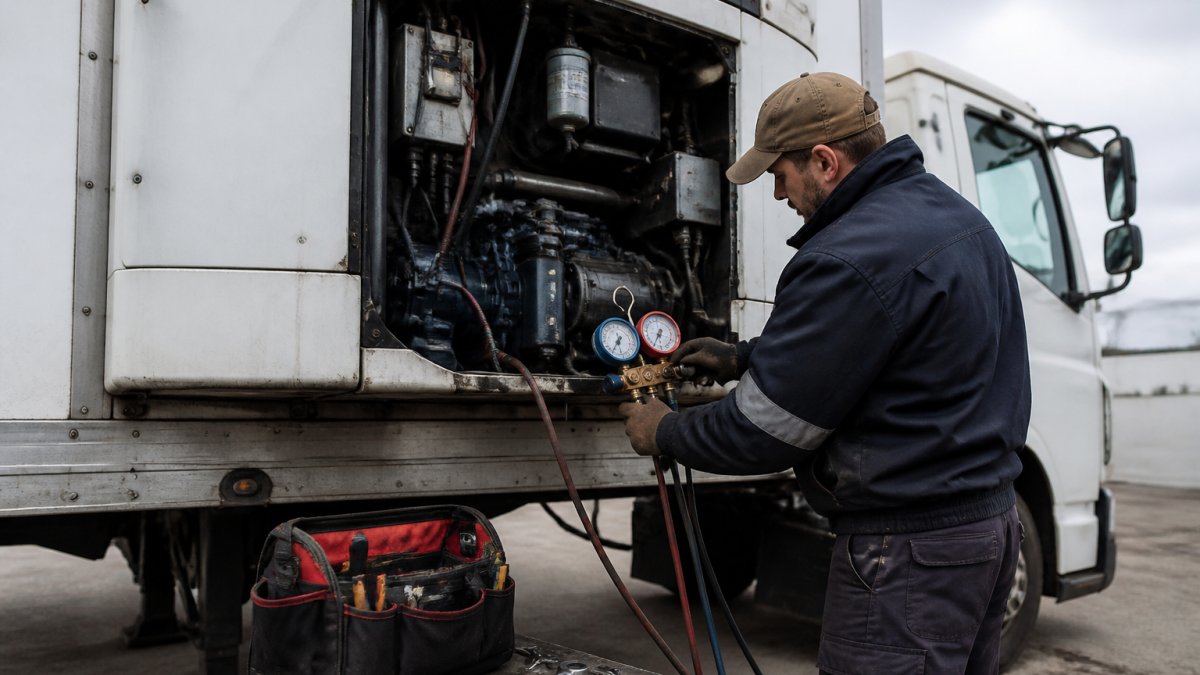
Verify refrigerant charge with a proper gauge set against the manufacturer's specification rather than guessing from sound or appearance.
Inspect insulation panels for cracks, delamination, or moisture; soft or discolored panels indicate a thermal barrier problem.
Quarterly and seasonal checks:
Perform a full unit diagnostic scan and review stored fault history, not just active codes.
Pressure-wash the trailer interior and confirm drain paths are clear before peak season.
Re-torque mounting hardware and inspect the unit's frame and mounts for vibration damage.
Pre-Trip Inspection Steps for Drivers
Drivers are your first line of defense. A short, consistent pre-trip inspection catches most problems before the trailer leaves the yard.
Verify the set point and that the unit starts and runs normally.
Walk the trailer and check door seals and locks.
Confirm the temperature display and data logger are working.
Note any warning lights or fault codes and report them before departure.
Record the inspection with the date, time, and any issues found.
Watch out: Do not dismiss a fault code because the unit still runs. Intermittent codes can precede a full failure on the highway, and a code that clears on its own is still worth logging.
Refrigerant, Battery and Electrical Checks
These three systems cause a large share of unplanned repairs, and they are easy to check on a schedule. Verify refrigerant charge with a proper gauge set rather than guessing from sound or appearance. Load-test batteries monthly, because a battery can look fine and still fail under cold-start demand. Inspect wiring and terminals for corrosion, and tighten or clean connections as needed.
Assigning Ownership and Recording Results
A checklist only improves reliability if someone owns each item and the results are recorded. Assign daily checks to the driver, weekly checks to a lead driver or yard technician, and monthly checks to a qualified technician. Keep a single log per trailer so repeat failures are visible, and review the log monthly to spot patterns such as repeated battery failures on one route or repeated seal damage on one loading dock.
Refrigerated Trailer Preventive Maintenance Intervals and Inspection Criteria
Preventive maintenance works best when it follows defined intervals and measurable criteria. Instead of relying on "looks fine," set pass-or-fail thresholds for each inspection item.
Inspection Item | Interval | Pass Criteria |
Door seals | Daily | No tears, gaps or hardening |
Temperature log | Daily | Within set point tolerance for the full trip |
Coils | Weekly | Clean, with no visible blockage |
Belts | Weekly | Proper tension, no cracks |
Battery load test | Monthly | Holds voltage under load |
Refrigerant level | Monthly | Matches manufacturer specification |
Insulation | Monthly | No cracks, delamination or moisture |
Check the manufacturer's maintenance manual for the exact specifications on your unit, because intervals and values vary by model. Use the table as a framework, not a substitute for the manual.
Troubleshooting Reefer Unit Failures Before They Strand a Load
When a unit fails on the road, a calm, ordered check saves time. Start with the simplest possible causes.
Unit will not start: Check battery voltage, fuses and main connections first.
Cooling is weak: Check the set point, door seals and coil cleanliness before suspecting refrigerant.
Temperature swings: Look for a failing fan motor, worn belt or a door that is not sealing.
Document what you found and what you changed. Repeat failures often point to a root cause that a single repair does not solve.
Watch out: Opening the doors to check the load raises the internal temperature quickly. Keep door openings brief and log the time.
How to Reduce Refrigerated Transport Downtime Across Your Fleet
Downtime is the time a trailer is out of service. To reduce it across a fleet, you need to measure it, diagnose it, and schedule around it. The sections below give you a metrics framework and a symptom-to-cause guide that most broad maintenance articles skip.
Track Reliability Metrics That Show Whether Improvements Work
You cannot manage downtime you do not measure. Start with a small set of metrics and review them monthly:
Breakdown rate: unplanned unit failures per trailer per month. A rising rate on one trailer points to a root cause rather than bad luck.
Temperature excursions: trips where the load temperature moved outside the set point tolerance. Track the count and the duration of each excursion.
Uptime and downtime hours: hours in service versus hours out of service, including waiting time for parts and technicians.
Benchmark each trailer against the fleet average and against its own prior quarter. A trailer that is consistently above the fleet average on breakdown rate or repair time is a candidate for a root-cause inspection rather than another single repair.
Diagnose Failures With a Symptom-to-Cause Guide
When a unit fails on the road, a calm, ordered check saves time. Start with the simplest possible causes and work toward the more expensive ones.
Unit will not start: check battery voltage, fuses, and main connections first. A corroded ground or a weak battery under cold-start load is a common cause.
Cooling is weak: check the set point, door seals, and coil cleanliness before suspecting refrigerant. A dirty condenser coil or a torn door seal can mimic a low-charge condition.
Temperature swings: look for a failing fan motor, worn belt, or a door that is not sealing. A fan that runs intermittently can cause swings that do not show up on a short check.
Document what you found and what you changed. Repeat failures often point to a root cause that a single repair does not solve.
Watch out: Opening the doors to check the load raises the internal temperature quickly. Keep door openings brief and log the time.
Standardize Procedures and Schedule Repairs in Advance
Standardize inspections so every driver and technician follows the same steps and records results in the same log.
Track failures by type to find patterns, such as repeated battery failures on one route or repeated seal damage at one dock.
Schedule repairs in advance so units are serviced during planned downtime, not during a load.
Many fleets also keep a short list of critical spare parts on hand, such as belts, fuses, and common sensors. This shortens repair time when a unit must return to service quickly.
For fast response when a unit fails away from the yard, Platinum Transport Refrigeration Services provides 24-hour emergency mobile repair, so a stranded load does not have to wait for a unit to reach a depot. Fleets can book mobile Thermo King reefer repair before a load is stranded.
What Reefer Trailer Repair Costs Look Like and How to Plan for Them
Repair costs depend on the failure, the unit's age and the parts needed, so exact figures vary widely. Planning helps keep those costs predictable.
Pricing for mobile service depends on the work required, the unit and the timing. For current rates or a quote, contact Platinum Transport Refrigeration Services directly. Our guide to reefer unit warranty coverage explains what may offset these costs.
Scheduling Your Next Reefer Inspection With Platinum Transport Refrigeration Services
A reliable reefer fleet is built on routine inspections, clear records and fast access to repair. Start by setting your daily, weekly and monthly checks, and assign each one to a named person.
When you are ready to put a schedule in place, Platinum Transport Refrigeration Services can inspect your units and set up a maintenance plan that fits your routes.
Frequently Asked Questions
How often should a reefer trailer be serviced?
Most fleets pair a daily pre-trip inspection with a scheduled service at intervals set by the refrigeration unit manufacturer, commonly every few hundred operating hours or at least quarterly for active units. Check the unit's hour meter, refrigerant levels, belt condition, coil cleanliness and defrost operation at each service. Keep a written log for every trailer so you can spot patterns, such as a unit that loses set point each time it runs in high ambient temperatures, before a load is lost. Adjust intervals upward for trailers that run long hours or haul in dusty or high-heat conditions.
What should drivers check before a refrigerated load?
Drivers should confirm the set point and return air temperature, verify the unit starts and runs without alarms, and check that the defrost cycle and fuel or battery level are adequate for the trip. They should also inspect door gaskets, drain plugs and the condition of the bulkhead and airflow paths, which are often overlooked. Recording the pre-trip readings on a checklist gives the shop a baseline and makes it easier to tell whether a problem developed during the run or before it started.
How can fleets reduce refrigerated transport downtime?
Downtime drops when fleets catch faults early and stock the parts that fail most often. Scheduled preventive maintenance, real-time temperature monitoring with alerts, and a rapid-response repair provider with mobile service and parts on hand all shorten the time a trailer sits idle. Tracking mean time to repair for each unit shows where delays happen, whether that is waiting for parts, diagnosis or scheduling a shop bay.
What are the most common causes of reefer trailer breakdowns?
The most frequent causes include refrigerant leaks, worn compressor belts, failing condenser or evaporator fan motors, faulty temperature sensors, and electrical problems in the battery or wiring. Poor door seals and dirty coils also reduce capacity and force the unit to work harder, which accelerates wear. A structured troubleshooting process that starts with the alarm codes and temperature history usually isolates the cause faster than replacing parts by guesswork.
Comments