The Complete Reefer Unit Maintenance Guide for 2026
Last Updated: November 12, 2026
Quick Summary
Effective reefer unit maintenance follows a three-tier A, B and C service schedule triggered by engine hours rather than calendar dates, with each tier building on the last. Every visit should cover oil and filter changes, coolant and belt checks, electrical wiring inspection, condenser coil cleaning, and defrost and drain service.
A service covers oil checks, belts, coolant and a visual walkaround; C service adds compressor and refrigerant leak inspection.
Engine hours are a more reliable service trigger than calendar dates because continuously running units accumulate wear faster.
Condenser coil cleaning is the most overlooked task, and a fouled coil makes the compressor run hotter and longer.
Drivers should reset a fault code only once and call for service if it returns rather than pushing the load.
Maintenance records double as FSMA compliance documentation and should be kept in an exportable format.
Is your reefer unit due for service?
Platinum TRS provides 24/7 mobile reefer repair and maintenance across the Tri-Cities and the region.
Table of Contents
Why Reefer Unit Maintenance Decides Your Cold Chain in 2026
A reefer unit that fails mid-route puts an entire load at risk, and in temperature-sensitive freight, the cargo is often worth far more than the equipment carrying it. This reefer unit maintenance guide covers the schedules, service tasks, and inspection routines that keep transport refrigeration units running and cold chain integrity intact.
Your Reefer Unit Maintenance Schedule by Service Interval
A reefer unit maintenance schedule organizes service into three tiers, commonly labeled A, B, and C service. Each tier builds on the last, so a C service includes everything in A and B plus deeper inspection. The schedule below reflects how most fleets structure intervals around engine hours rather than calendar dates.
A, B, and C Service Tiers Explained
A service is the lightest interval: oil and filter checks, belt inspection, coolant level verification, and a visual walkaround. B service adds fuel and air filter replacement, electrical wiring inspection, and condenser cleaning. C service is the full inspection, covering compressor performance, refrigerant leak detection, defrost system function, and a complete diagnostic scan.
Engine Hours vs. Calendar Intervals
Engine hours are the more reliable trigger. A unit that runs continuously accumulates wear far faster than one that sits between short routes, so a calendar-only schedule lets hard-working units fall behind. Track hours in your maintenance log and set service triggers against them. Calendar intervals still matter for low-use units, since seals, belts, and gaskets degrade with time regardless of runtime.
Service Tier | Typical Trigger | Core Tasks |
A service | Frequent, low-hour interval | Oil check, belt inspection, coolant level, visual walkaround |
B service | Moderate hour interval | A service plus fuel/air filters, wiring check, condenser cleaning |
C service | Annual or major hour milestone | B service plus compressor, refrigerant leak, defrost, full diagnostics |
The Core Service Tasks Every Unit Needs
Every transport refrigeration unit, regardless of brand, depends on the same core systems. Skipping any one of them shortens unit life and erodes thermal efficiency. Here is what each service visit should cover.
Oil, Fuel, and Air Filter Replacement
Engine oil and filter replacement protects the compressor drive system from wear. Contaminated fuel is a leading cause of hard starting and power loss on diesel reefer units. Air intake filters clog gradually, and a restricted intake forces the engine to work harder, raising fuel consumption and heat. Replace filters on the hour interval your manual specifies, and inspect them at every A service.
Coolant, Belts, and Electrical Wiring
Coolant levels and condition affect how well the unit sheds heat under load. Low coolant or a degraded mix invites overheating on long hauls. Belt tensioning deserves a hands-on check at every service, since a loose belt slips and a tight one wears bearings. For Carrier units, our Carrier reefer repair team handles model-specific service; Thermo King owners can reach our Thermo King repair specialists for the same dealer-level attention.
Condenser Coils, Evaporator Fans, and Defrost Drains
Condenser coil cleaning is the single most overlooked task on most units. A fouled coil cannot reject heat, and the compressor runs hotter and longer as a result. Evaporator fan blades should be checked for cracks and balance. Defrost cycle function and drain hose cleaning prevent ice buildup and water intrusion into the cargo space.
The Reefer Unit Maintenance Checklist Technicians Actually Use
A reefer unit maintenance checklist keeps service consistent from one visit to the next. Our technicians work from a fixed list so nothing gets skipped under time pressure:
Check engine oil level and condition; replace oil and filter per interval
Inspect and replace fuel and air filters as needed
Verify coolant level and concentration

Reefer Pre-Trip Inspection Checklist for Drivers
A reefer pre-trip inspection checklist catches problems before the truck leaves the yard. Drivers should run it every time, not just on long hauls. Check the unit starts and reaches setpoint, confirm the defrost cycle runs, inspect door gaskets, verify fuel level, and look for refrigerant oil traces that suggest a leak.
Reefer Unit Troubleshooting: What the Alarm Codes Tell You
Reefer unit troubleshooting starts with the diagnostic trouble codes the controller displays, but the code is only the entry point. The useful skill is knowing which codes a driver can act on at the dock and which ones mean the load stops moving until a technician arrives. The categories below cover the fault families that account for most roadside reefer calls.
Temperature and Airflow Faults
A high-temperature alarm is the most common reefer fault, and it rarely means the refrigeration circuit has failed. The usual causes, in rough order of likelihood, are airflow restriction from a blocked or improperly loaded trailer, a failing evaporator fan, a door left open or a failed door gasket, and a defrost cycle that never terminated.
Refrigerant and Pressure Faults
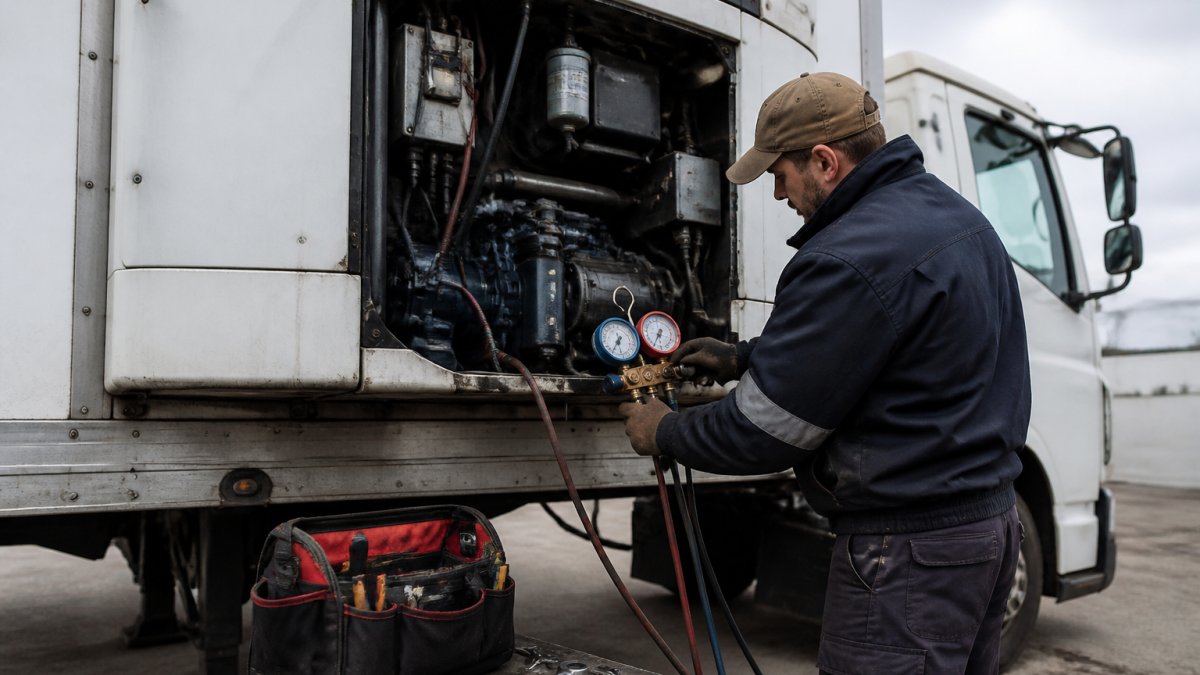
Low-pressure and refrigerant-level faults point to a leak, and a leak will not fix itself. A driver should look for oil traces at fittings and joints, refrigerant oil migrates to the leak point, and note the code before doing anything else. Do not add refrigerant to clear a low-pressure fault without leak detection; topping off a leaking system masks the problem and pushes the failure down the road.
Defrost and Sensor Faults
Defrost-related codes usually trace to a stuck termination sensor, a clogged drain hose, or a failed defrost heater. A unit that ices over on the evaporator coil cannot move heat, and the resulting temperature alarm looks like a refrigeration failure when it is really a defrost failure. Drain hose blockages are a frequent cause and are visible on a walkaround.
Electrical and Controller Faults
Electrical faults range from a chafed wiring harness to a corroded connector to a controller that needs a software update. A driver can check the obvious, battery connections, visible harness damage, blown fuses, but intermittent electrical codes that clear on their own are the hardest to diagnose and should be written down with the conditions under which they appeared (ambient temperature, engine load, time since start).
The Reset Decision
Write the code down before you reset anything. A driver facing an active alarm can reach our 24/7 emergency reefer repair line for immediate help.
Fault Family | Typical Driver Action | Technician Required? |
High temperature / airflow | Check load placement, door seals, evaporator fans | Only if airflow is confirmed good and temperature still climbs |
Low pressure / refrigerant | Look for oil traces, record code, do not top off | Yes |
Defrost / sensor | Check drain hose, record sensor named by controller | Yes for sensor and heater faults |
Electrical / controller | Check battery, fuses, visible harness damage | Yes for intermittent or repeat codes |
Watch out: a code that clears after a reset does not mean the fault is gone, it means the controller has not yet re-detected it, and a load pushed on that assumption is the most common way a manageable repair becomes a cargo claim.
Telematics, Compliance Records, and the Outsourcing Decision
Most reefer maintenance guides stop at the checklist. The operational layer that actually determines whether a fleet avoids a mid-route failure sits in three areas: what the unit reports about itself, what records you can produce on demand, and who turns the wrenches. Each deserves its own plan.
Telematics and Predictive Maintenance
Modern transport refrigeration units expose a data stream through the controller and the telematics gateway: engine hours, fault code history, setpoint versus actual box temperature, defrost cycle frequency, and fuel consumption.
A practical predictive routine looks like this:
Pull engine hours weekly and reconcile them against your service triggers, not against the calendar.
Watch fault code history for repeat codes that were cleared but never diagnosed. A code that returns after two resets is a pending failure, not a nuisance.
Track setpoint deviation during pull-down. A unit that used to reach setpoint in 20 minutes and now takes 40 has a heat-rejection problem, usually a dirty condenser or a weak condenser fan.
Watch out: telematics dashboards that only surface active alarms hide the trend data you need for predictive scheduling, confirm your platform retains and exports historical fault and temperature logs before you rely on it.
Compliance Documentation That Satisfies FSMA
The Food Safety Modernization Act shifted food safety from reactive to preventive, and its Sanitary Transportation rule puts the burden on shippers, loaders, carriers, and receivers to demonstrate that temperature-sensitive freight was kept at safe temperatures. In practice, that means your maintenance records are compliance records. An auditor or a customer's quality team may ask for:
Temperature logs showing the box held setpoint for the duration of the haul, with time stamps.
Pre-cooling records confirming the trailer was brought to temperature before loading.
Maintenance and repair records for the reefer unit covering the period in question, including any fault codes and the corrective action taken.
Build a maintenance log template that captures unit identifier, date, engine hours, service tier performed, parts replaced, fault codes found and cleared, and technician sign-off. Keep it in a format you can export, a spreadsheet or your telematics platform's report function, because a paper binder that lives in a truck cab will not survive an audit request.
In-House vs. Outsourced Service: A Decision Framework
The build-or-buy question for reefer service comes down to volume, geography, and specialization.
Outsourcing to a mobile provider makes sense when your fleet is regional or dispersed, when your units are under warranty or dealer-specific, and when you would rather convert a fixed staffing cost into a variable per-service cost.
One common approach for regional fleets is a hybrid: drivers and yard staff handle the pre-trip inspection and the A-level checks, while a mobile provider performs B and C service and all diagnostic work.
Book Mobile Reefer Service Before Your Next Load
Preventive maintenance only pays off when someone actually does the work on schedule. Confirm coverage for your location through our reefer repair service area, then schedule service before the next load goes out.
Reactive maintenance feels cheaper until a unit fails with a full load aboard. Platinum Transport Refrigeration Services offers 24-hour emergency reefer repair, 100% mobile service, and dealer-level expertise backed by parts carried on-site.
Frequently Asked Questions
How often should reefer units be serviced?
Most transport refrigeration units follow a three-tier reefer unit maintenance schedule. A-service checks run every 1,000 to 1,500 engine hours or roughly every 90 days, covering oil, filters, belts, and a visual inspection. B-service adds coolant testing, coil cleaning, and refrigerant leak detection at about 3,000 hours. C-service is the annual deep service with oil analysis and full electrical diagnostics. Units running high hours in summer heat should be inspected closer to the low end of each window.
What is considered high hours on a reefer unit?
On trailer reefer units, 10,000 to 15,000 engine hours is often where major component wear shows up, and anything past 20,000 hours is generally treated as high-hour equipment. Hours matter more than age because a unit running continuous temperature control accumulates wear faster than one used seasonally. High-hour units need oil analysis at every service and closer monitoring of compressor performance, belt tensioning, and refrigerant charge to catch problems before a load is at risk.
What should drivers check during a reefer pre-trip inspection?
A reefer pre-trip inspection checklist should cover setpoint and actual box temperature, fuel level, oil and coolant levels, belt condition, condenser coil cleanliness, door gaskets, and any diagnostic trouble codes on the controller. Drivers should also confirm the defrost cycle completes and the drain hose is clear. Log the readings before departure so a temperature drift or fault code is caught at the dock instead of mid-route, when a rejected load costs far more than the inspection.
What are common signs that a reefer unit needs repair?
Watch for temperature readings that drift from setpoint, longer pull-down times after loading, frequent defrost cycles, unusual noise from the evaporator fan, and repeated diagnostic trouble codes. Oil or refrigerant residue around fittings points to a leak. Any of these signals warrants reefer unit troubleshooting by a technician before the next temperature-sensitive haul. Ignoring early warnings is how a minor belt or coil issue turns into a mid-route breakdown and a spoiled load.
How can reefer unit downtime affect cold chain integrity?
A failed unit can let box temperature climb out of range within minutes on a hot day, and many grocery and pharmaceutical receivers reject loads that break the temperature record. That means a single breakdown can cost the cargo, the delivery window, and the customer relationship. Preventive maintenance and a documented service log protect cold chain integrity by catching worn belts, low coolant, and dirty coils before they cause a failure on the road.
Should we outsource reefer maintenance or keep it in-house?
In-house service makes sense only if you have certified technicians, diagnostic tools, and stocked parts for every unit in your fleet. Mobile service adds the benefit of repairs at your yard or roadside, which protects fleet uptime. Compare the fully loaded cost of in-house labor against your actual breakdown history before deciding.
Comments